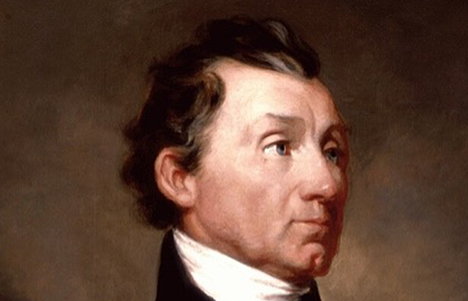
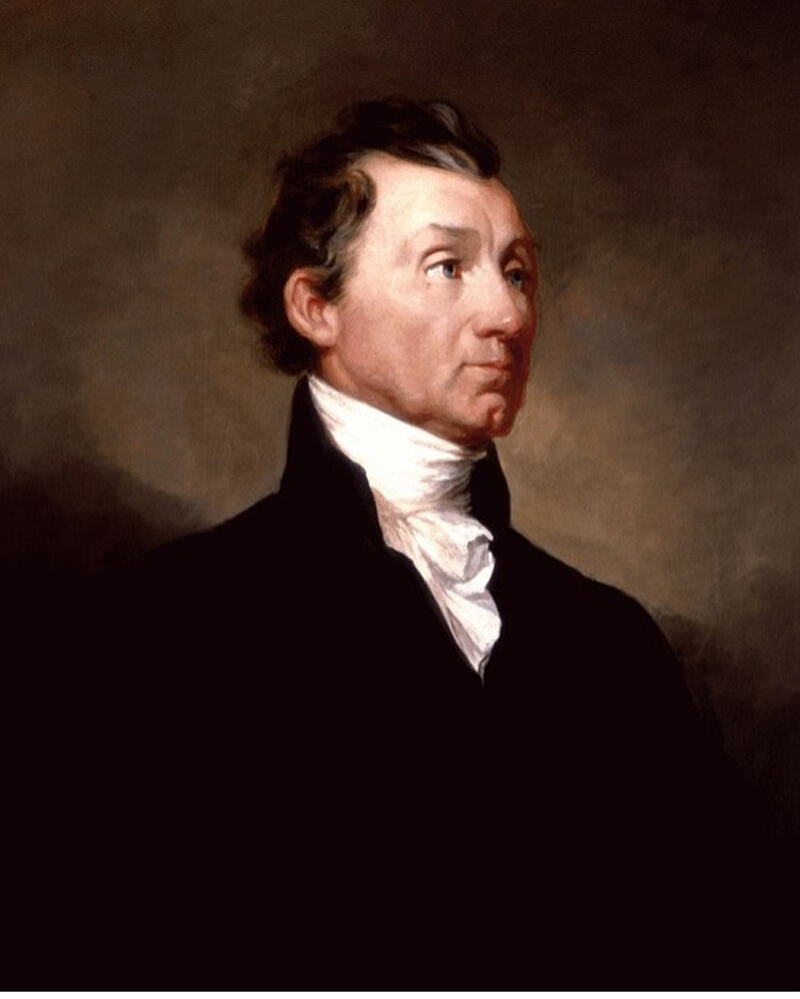
Born this day on April 28, 1758, James Monroe was a Revolutionary War soldier, a diplomat, a Governor of Virginia, a U.S. Senator, and our fifth President of the United States. He is known for having formulated what became known as the “Monroe Doctrine,” a cornerstone of American foreign policy that asserted the Western Hemisphere was off-limits to European colonization, but which also served as the political rationale for America’s relentless acquisition of Western lands. His presidency also marked the “Era of Good Feelings,” characterized by national unity and economic growth. Monroe championed internal improvements, such as road and canal construction, and supported the Missouri Compromise of 1820, an admittedly flawed federal law, but which temporarily eased tensions over slavery.
Monroe was born in Westmoreland County, Virginia, and grew up in a family of modest means. His father, Spence Monroe, was a farmer and carpenter, and his mother, Elizabeth Jones Monroe, managed the household. Despite his humble beginnings, Monroe was an able student: he was educated at Campbelltown Academy, and later enrolled at the College of William and Mary in 1774, but never finished: when the Revolutionary War broke out in 1775, Monroe joined the Continental Army, and participated in significant battles like the Battle of Trenton, where he was severely wounded, and the Battle of Monmouth. During the War, he became friends with men who would become important people in his later life: George Washington, Alexander Hamilton, the Marquis de Lafayette, and Thomas Jefferson, to name a few.
Monroe’s political career in the federal and state governments began in 1782 when he was elected to the Virginia House of Delegates. A year later, he served in the Continental Congress, where he advocated for the expansion of American territory and the creation of a strong federal government. Although he was not in government when Congress passed the U.S. Constitution, he did serve as a Delegate at Virginia’s Ratifying Convention in 1788, where he pressed for inclusion of a Bill of Rights (which was not adopted at that time), and ultimately voted against ratification for that reason. In 1790, Monroe was elected to the U.S. Senate, where he gained a reputation as a staunch advocate for states’ rights and individual liberties. Monroe’s diplomatic career took off when President George Washington appointed him as Minister to France in 1794. During his tenure, he played a key role in negotiating the Louisiana Purchase, which doubled the size of the United States, and triggered a massive expansion of the United States into the West, ultimately to the Pacific Ocean. Monroe later served as Secretary of State and Secretary of War under President James Madison during the War of 1812.
During his political career, Monroe was a close protégé of Thomas Jefferson and James Madison, with whose support he was propelled into the White House in 1817. After the end of his second term as President in 1825, he retired to his Virginia estate, Oak Hill. He struggled financially and faced personal losses, including the death of his wife, Elizabeth, in 1830. Monroe spent his final years living with his daughter in New York City, where he passed away on July 4, 1831 at the age of 73, having seen the nation transform itself from being a mere British Colony to a world power.
So today we honor James Monroe for his bravery on the battlefield, his diplomatic and political leadership, and his vital role in shaping the nation’s identity during its formative years. He was the last of the Virginians to lead our country in its first three decades, and who set the stage for the conquering of the American West.