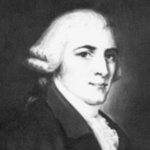
One of the most famous leaders of the rebellion that led to our American Revolution was John Hancock, born this day on January 23, 1737. Hancock was an unlikely warrior—he was not a military man, but was instead a wealthy Boston businessman, who became a major supporter of “The Cause,” in no small part by donating generous amounts of his personal fortune to the rebels, and by his leadership of the Massachusetts Provincial Congress created in response to the abuses being committed upon the people of Massachusetts by the British government. After war broke out in April 1775, Hancock took on an even more prominent role in the new national government: he was the President of the Continental Congress for its first two years of existence (1775-1777), and was a key member of the American “brain trust” throughout the war effort. After the war ended with the Treaty of Paris in 1783, Hancock continued to serve his country as Governor of Massachusetts, including during the critical years when our Constitution and Bill of Rights were being created.
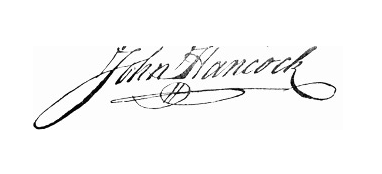
Hancock was in some respects an accidental leader. Born in Braintree, Massachusetts to an upper middle-class family, Hancock was raised by his uncle after his father died in 1744, when John was only 7 years old. His uncle became one of the wealthiest men in Boston, and when the uncle died in 1764, John inherited the uncle’s business, and his fortune. Suddenly, at age 27, Hancock was one of the most powerful and well-connected men in Boston. Almost immediately he was swept up in the revolutionary fervor that began in 1763 with the end of the French and Indian War, and the commencement of efforts by the British government to tax American colonists as a means of eliminating the massive debts it had piled up during that war. The Sugar Act of 1764 was the “kick-off” of these taxes, and exacerbated by the Navigation Acts (1763), the Stamp Act (1765), the Townsend Acts (1767), the Tea Act (1773), the Coercive Acts (1774), and similar heavy-handed and increasingly harsh measures. Two of the most famous confrontations were the Boston Massacre (1770) and the Boston Tea Party (1773). Through it all, Hancock attempted to “thread the needle” by trying to protect his business interests while also supporting the rebellion. Ultimately, he had to make a choice, and he chose to support the cause of independence. Most famously, he was the first man to sign the Declaration of Independence, and his bold signature on this historic document has become iconic.
Hancock did not allow the Revolution to interfere with his courtship of Dorothy “Dolly” Quincy, who became his wife in August 1775. They had two children, a son and a daughter, but sadly neither of them survived childhood. During this time period, Hancock also became involved in a dispute with his alma mater, Harvard College, over his alleged misappropriation of funds in his role as treasurer of the college, leading to his removal, and great damage to his reputation. The dispute was never resolved during his lifetime. Hancock died in 1793, the same year that George Washington was reelected president of the United States. Hancock’s wife Dolly outlived him by many years; she passed away in 1830.
Today, we honor John Hancock on the 288th anniversary of his birth in 1737. He has gone down in history as one of the greatest Patriots of the Revolutionary era.