
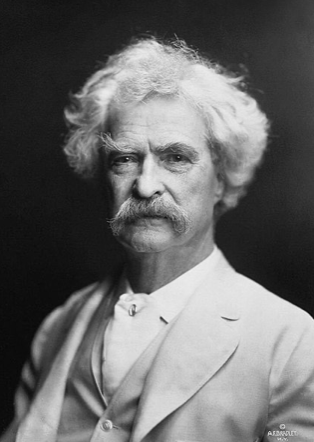
One of the greatest writers in American history was born this day on November 30, 1835. Samuel Langhorne Clemens, whose “pen name” was Mark Twain, was the son of John and Jane Clemens. Growing up in Hannibal, Missouri, Twain developed wanderlust early on, never going past fifth grade in his education, and taking his first job at age 16. His grandest adventure as a young man was working as a steamboat pilot on the Mississippi River, a time in his life made famous in his book Life on the Mississippi. It was from this line of work that he got his pen name “Mark Twain” (a term used by steamboat captains to describe a water depth of twelve feet, which was a safe depth for a steamboat to traverse).
Twain’s career is not easily summarized, except to say that it was eclectic and adventurous. He was (briefly) a Civil War soldier (for two weeks in a Confederate unit); a government functionary, miner and newspaperman in Virginia City, Nevada (the center of the Comstock Lode); a friend and advisor of President Ulysses S. Grant (and editor of Grant’s auto-biography); a lecturer and public speaker; and, of course, a celebrated humorist and author. It was in California that Twain first became a literary success, with such books as The Celebrated Jumping Frog of Calaveras County, Roughing It, The Adventures of Tom Sawyer, and The Adventures of Huckleberry Finn. He traveled the world, and used those experiences as the basis for well-received books such as The Innocents Abroad or The New Pilgrims’ Progress, The Gilded Age: A Tale of Today, and A Connecticut Yankee in King Arthur’s Court. Twain’s last novel published in his lifetime was A Horse’s Tale, published in 1907. For over 40 years, he entertained Americans with his wit and wisdom, and continues to do so today, a century after his death in 1910.
Twain’s life outside of the realm of literature was tragi-comic. He dabbled in business, but he fared poorly, and although he did well from the sale of his books, lecture fees, etc., he suffered financial setbacks along the way from failed business dealings and investments (he filed for bankruptcy at one point). Twain married Olivia Langdon in 1870, and through her family he developed relationships with a wide range of politicians, social activists, inventors, literary figures, financiers, and high-society movers and shakers. Twain and his wife had four children together, and lived in New York and Connecticut for over two decades. He later went to Europe with the family, where he served as a European correspondent to various newspapers, then went on a round-the-world speaking tour in 1895. He continued living in Europe until 1901. Olivia died in 1904, and Twain returned to New York. He died there of a heart attack in 1910, and was buried next to his wife in her family plot in Elmira, New York. Twain’s contributions to American literature will never be forgotten. We honor him today on the 189th anniversary of his birth—a man who made us laugh, and whose writings truly captured the spirit of American life in the 19th century.