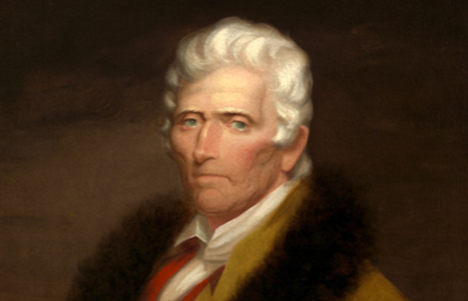
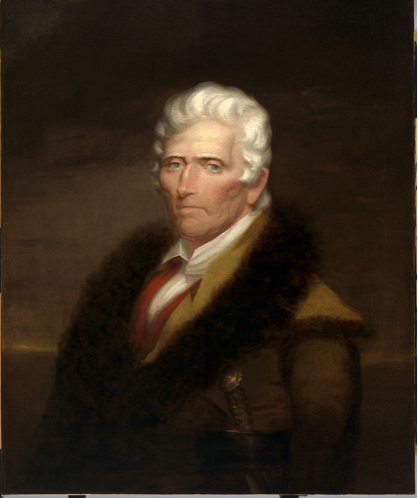
One of the most famous trailblazers in American history was Daniel Boone, born this day 290 years ago on November 2, 1734. He was born into a family of Quakers, and was raised initially in Pennsylvania. His family moved to North Carolina in 1750 when Daniel was 16 years old. At a young age, Daniel developed a passion for hunting and exploring, and as a consequence he did not receive a formal education. He learned in other ways, however, and gained practical knowledge that stood him in good stead later in life. He spent considerable time in his youth interacting with native-Americans who lived alongside him in the Pennsylvania frontier. He also learned critical survival skills from his hunting. He received some tutoring from his family, enough so that he could read and write. Daniel is said to have brought books with him on his hunting trips, and sometimes read out loud to his fellow hunters.
What earned Boone lasting fame was his role in blazing a trail through the “Cumberland Gap,” which allowed settlers to pass from North Carolina into the rich agricultural region that became known as “Kentucky.” It was in 1769 that he and a few other courageous trailblazers embarked on the 2-year expedition that took them through the Gap. So captivated was Boone by what he saw that after returning to his family in North Carolina, he moved to Kentucky in 1773 with his family and other settlers. While en route, Boone’s son James took a tragic side-trip, during which his party was attacked by a Indians, and he was killed. Boone was necessarily devastated, but he continued the journey, and ultimately founded the settlement that took his name, “Boonesbourgh,” near today’s Lexington Kentucky. The publicity about Boone’s discovery of the route through the Cumberland Gap into Kentucky triggered a massive migration of hundreds of thousands of people to Kentucky over the next several decades.
Shortly after founding Boonesborough, Boone became involved in the Revolutionary War, which extended into the Western frontiers where various tribes had allied with the British army. In April 1778, Shawnee warriors laid siege to Boonesborough. Over the course of the next six months, Boone sought peace with the Shawnees, causing some of the settlers to question his loyalties. Boone was abused by his own people, and at one point charges were brought against him. While he was found not guilty, Boone’s reputation had been seriously—but not irrevocably—damaged. He went on to become a Lt. colonel in the militia, and also became a member of the General Assembly in Virginia (in which Kentucky was a district). Boone also fought with American forces during the War, and participated in the invasion of the Ohio territory under the command of George Rogers Clark. His last significant battle was the Battle of Blue Licks in 1782—after Yorktown, but before the War officially ended in 1783.
Boone’s later years were spent pursuing a series of failed careers—tavern keeper, surveyor, horse farmer, etc.—and he fell into serious financial difficulties. Yet, during the 1780’s the popular press turned Boone into a celebrity of sorts, and Kentucky named a county after him—Boone County. He later moved to Missouri in 1799, and lived a comparatively quiet life with his family until his death in September 1820. He and his wife Rebecca had ten children, and by many accounts he was a devoted family man in his final years. He was still hunting and exploring well into his 80’s. He died at the age of 86. Today, we honor his memory as one of the greatest frontiersmen in our nation’s history.