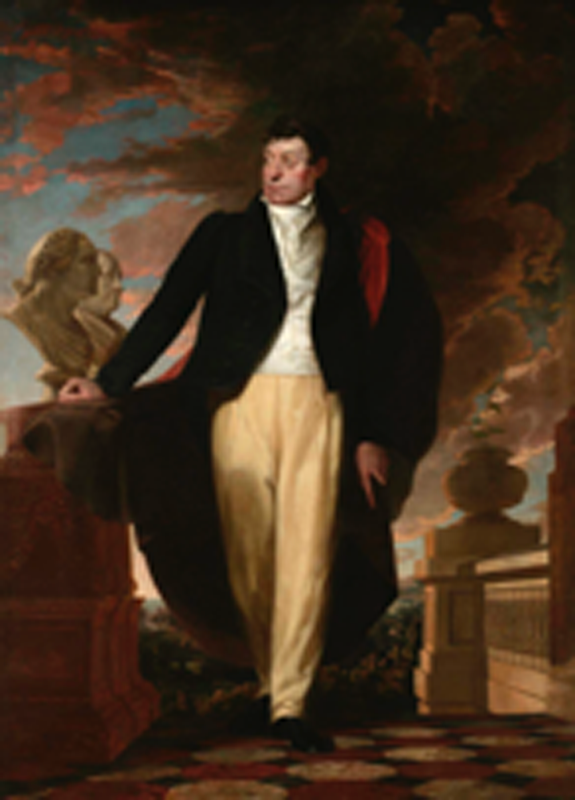
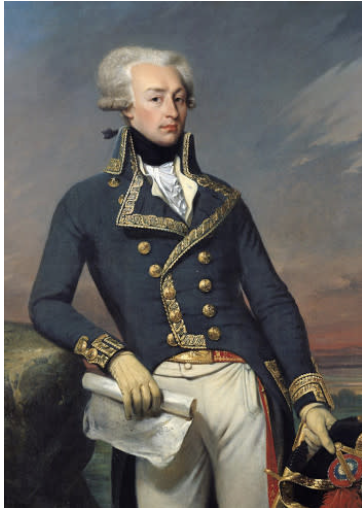
Last August we posted a story about the Marquis de Lafayette’s famous Tour of America in 1824-25. Lafayette was a Frenchman who joined America’s Continental Army as a teenager and rose to be a General, and a close friend of General Washington. In 1824, he was the last living General, and as I wrote last year, his arrival was met with wild celebrations, parades, banquets, and throngs of people lining the streets of America’s cities and towns to greet him. (click here to read that story). Last year, the 200th anniversary of his Tour of America was the subject of countless commemorations around our country. This year, not much is being said about the end of his Tour in 1825. Despite what we might describe as “Lafayette fatigue,” we want to honor Lafayette’s Tour of America once last time, and share the story of his last months in America before he returned to England on September 7, 1825.
RECAP: THE 2024 TOUR
The story begins with a quick recap: as the map below depicts, Lafayette’s tour was a prodigious effort to visit all the then-24 states in the Union, travelling on land and sea. He covered over 6,000 miles over the course of 13 months, during which he visited with no less than six past, present and future American presidents. He also met with a huge number of ordinary citizens, town leaders, native-Americans, and various civic and charitable organizations. He also was tireless in his efforts to meet-and-greet as many of former Revolutionary War soldiers, who turned out to pay homage to the former General. From mid-August to mid-October of 1824, Lafayette paid visits to over 40 cities and towns in New York, Connecticut, Massachusetts, New Hampshire, New Jersey, Delaware and Maryland. Everywhere there were parades, festivals, receptions, banquets and other celebrations to welcome the man who then-President James Monroe called “The Nation’s Guest.” Perhaps the most memorable visits were at the tail end of his 1824 itinerary, when Lafayette visited Mount Vernon (October 17) and Yorktown (October 18-19), and then enjoyed an extended visit with Thomas Jefferson at his home in Monticello (Nov. 2-8).

THE 1825 TOUR
The details of the General’s travels in 1825 were captured vividly by Lafayette’s personal secretary, Auguste Levasseur, who traveled with him on the Tour, and who kept a journal of the day-to-day events. His journal, written in French, was translated and published as “Lafayette in America in 1824 and 1825.” Beginning in Chapter III, he wrote about Lafayette’s travels in 1825, during which the General visited no less than 20 of our then-24 states. It was an unheard-of itinerary over land and sea, under conditions that would have deterred most travelers—impassable roads, rough waters (one of the boats carrying him capsized!), and harsh weather greeted him everywhere. Nevertheless, Lafayette was committed to visiting every single state in the Union, and commemorate the War in which he so valiantly fought.
February- June 1825: The Southern and Mid-West Tour
The Southern leg of Lafayette’s Tour of America began on February 23, 1825, when Lafayette set off by carriage to Raleigh, North Carolina. In the months of February and March, he spent considerable time in the Carolinas (35 days) and Georgia (10 days). April found him in Alabama (7 days) and Louisiana (9 days), and shorter “drive-by” visits (mostly by steamship) to Mississippi, Missouri and Illinois. In May he visited six states in the upper South and Mid-West: Ohio, Kentucky, Tennessee, Indiana, and West Virginia. In each state, he was honored in dozens of cities and towns along the way.
June 1825: Laying the Cornerstone at Bunker Hill

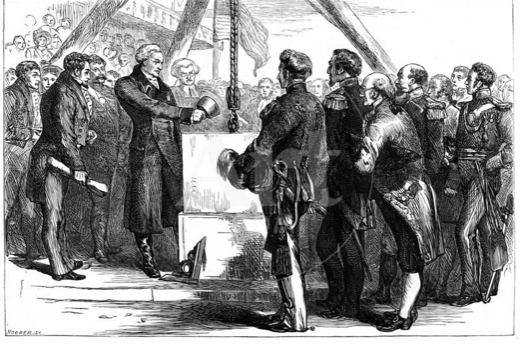
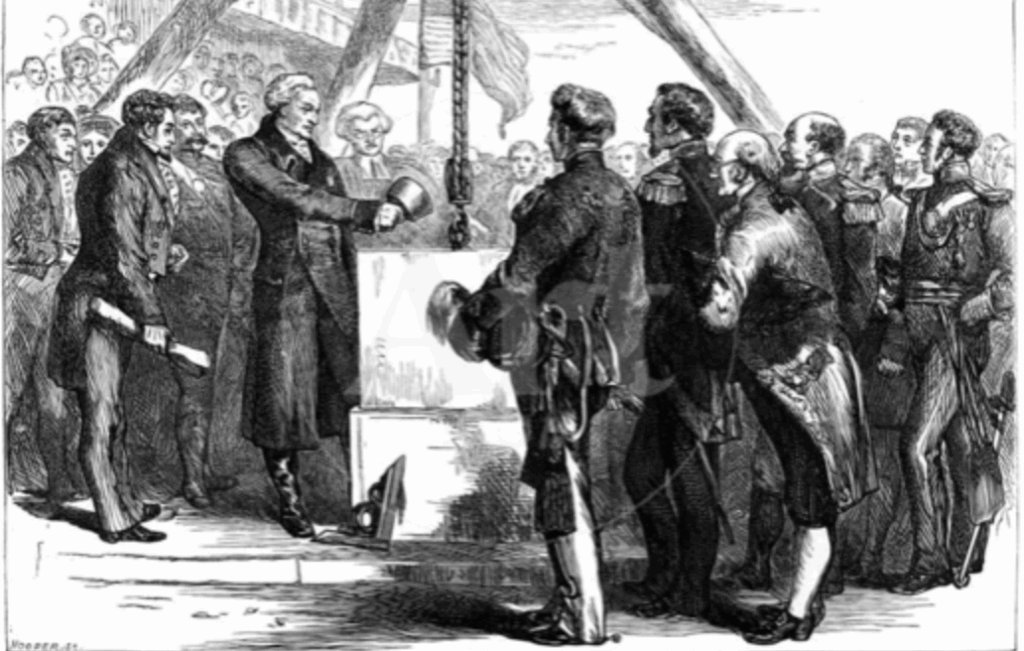
Almost all of June was consumed with visits to cities and towns in New York, Massachusetts, New Hampshire, Maine and Vermont. On and on he went, indefatigable, until mid-August. The highlight of his travels in the month of June was, of course, the laying of the cornerstone at Bunker Hill on June 17. It was a historic moment for Lafayette, for our country, and for France. In fact, the French press had followed the story of Lafayette’s Tour of America, and in May 1825 published a news story saying that “our eyes shall accompany him when on the 17th of next month, he will inaugurate with you the monument that Boston is raising for the brave men of Bunker Hill.” It was a long and moving story, in which the article declared the close bonds between America and France, and the love the French people had for Lafayette himself.
Hundreds of thousands of people turned out for the laying of the cornerstone, at the conclusion of which Lafayette insisted that several trunks of dirt from Bunker Hill be collected and sent back to France with him, with instructions that the dirt was to be laid on top of his grave upon his death. And so that’s what happened—Lafayette’s grave in Paris includes the dirt he had collected that day in June 1825.
The Final Two Months of the Tour
We turn now to the last two months of Lafayette’s Tour of America.

July 1825: Pennsylvania and Maryland
After the momentous cornerstone-laying ceremony at Bunker Hill, it was now time for Lafayette to finish his tour, which was set to end in late August. After leaving Boston, he passed through New Jersey on his way to Germantown (now a neighborhood in the north of Philadelphia), which was the site of one of the major battles in the Revolution in which Lafayette had fought in May 1778. There, a throng of dignitaries, soldiers and average citizens greeted him, one of whom gave him a present: a piece of the frigate The Alliance, on which Lafayette had crossed the Atlantic twice during the War.

The visit to Philadelphia was an extended one: eight days altogether, in which he was constantly busy with events and activities. Philadelphia was experiencing a massive heat wave, but “the General did not go out any less each day, whether to attend gatherings to which he had been invited, or to visit the environs of the City.”

After leaving Philadelphia, Lafayette went on to Brandywine, west of Philadelphia, which was the site of the first battle in which Lafayette had fought shortly after his arrival in America in 1777, and in which he was badly wounded. There, he was joined by a number of ex-soldiers and their families, who escorted him over the battlefield. Remarkably, Lafayette was told that an ex-soldier who had fought with him at Brandywine lived nearby and was dying, so Lafayette decided to pay him a visit. “Gideon Gilpin recognized him as soon as he entered, and showed him by tears of gratitude and affection how greatly this visit spread charm on his last moments and alleviated them.”
Lafayette spent the last few days of July visiting Lancaster, Pennsylvania and Baltimore, Maryland. In Lancaster, he was met by a group of clergymen who gave speeches in his honor. Lafayette said, “I accept with profound gratitude the displays of esteem and kindness that the religious ministers of this Town and the surrounding places have been pleased to bestow on me.”
Lafayette’s visit to Baltimore was equally moving. Although he didn’t arrive until midnight, “a large number of people were waiting for the arrival of the ship.” He spent two days there, where he mostly rested. Apparently, Lafayette “desired that there be no pomp and circumstance to mark his departure, and the citizens, always eager to satisfy his desires, were content to come in the evening to receive his farewells and to offer him the expressions of their regrets.” Yet, “the ceremony lasted several hours”—typical of the grueling nature of Lafayette’s Tour. Americans simply could not restrain themselves!
August 1825
Crossing the border from Maryland into Washington D.C. on August 1, Lafayette’s carriage was met by the son of newly-elected President John Quincy Adams, who invited him to stay at the White House, where his room was “simple, but comfortable and in good taste.” During his final weeks in the Nation’s capital, Lafayette found time to travel with the President to visit his old friend, former President James Monroe, who lived 30 miles away at his plantation, Oak Hill. They spent three days there, during which time people from all over came to pay their respects.
The Presidential retinue soon returned to Washington, and after a brief few days of rest, Lafayette was on the road again, visiting a number of towns in Virginia where, “in each of these towns, the passage of General Lafayette was marked by popular festivals.” But the main destination was Monticello, where Lafayette visited his friend Thomas Jefferson one last time. They were joined by former President James Madison. After several days of reminiscences, the two Founding Fathers bid farewell to Lafayette, never to see each other again.
Back in Washington, Lafayette was now on the eve of departing for France. President Adams had commissioned the building of a new ship to take him home, which was then being fitted out for the journey. Adams gave the ship the name Brandywine, in honor of Lafayette’s first military glory as a General in the Continental Army. The date scheduled for his departure was September 7, and when word got out, “a large number of citizens who wanted to receive the last farewells of the Nation’s Guest rushed here from all the surrounding towns.” Lafayette spent time “responding to the invitations that had been made to him by very many towns which the time and distances had not allowed him to visit.”
September 6-7, 1825: Lafayette’s Final Leave-Taking
On September 6 President Adams hosted a final farewell dinner for the General, attended by a large number of government officials and “distinguished persons.” Coincidentally, it was the General’s 68th birthday. At the dinner table, Adams made a toast to Lafayette, in response to which the General rose and gave his own toast to the assembled dignitaries: “To July 4, birthday of liberty in two hemispheres.”
After a night of feasting, the morning of September 7 “dawned radiantly; the workshops were deserted, the stores stayed closed, the people came in a crowd to press around the President’s mansion, and the militias lined up in battle array.” When Lafayette was ready to depart the White House, “the doors were opened so that the people assembled outside could witness the scene that was about to take place.” President Adams delivered a speech in which he recounted all that General Lafayette had done to help lead America to victory in the Revolutionary War, and all that he had done since then. Adams expressed the sentiments of the entire nation when he said “at the painful moment of parting from you, we take comfort in the thought that wherever you may be, our country will be ever present to your affections; we shall indulge the pleasing anticipation of beholding our friend again.”
Lafayette, obviously emotional, responded to President Adams with a short speech of his own, which he ended with these stirring words:
“God bless you, Sir, and all who surround us. God bless the American people, each of their States, and the federal government. Accept this patriotic farewell of an overflowing heart; such will be its last throb when it ceases to beat.”
With those words, Lafayette rushed into the arms of President Adams, “who mingled his tears, with his, while repeating sorrowfully these sad words: Farewell! Farewell!” He proceeded to his awaiting carriage, accompanied by 24 cannon blasts. Lafayette, hugged President Adams once more, then proceeded to the dock, where he would board the steamboat The Mount Vernon, which would take him to the ship that would carry him home, The Brandywine. Before boarding, he was greeted by the family of General Washington. When his ship finally left, an “innumerable crowd lined the shore of the Potomac for a great distance, dominated by the painful feeling that of regret that this departure inspired.”
Lafayette’s Legacy
Americans have honored the Marquis de Lafayette in countless ways: cities, parks, streets and schools have been named after him. Monuments and statues honoring him are too numerous to count. His image is found on one of the very first U.S. Mint commemorative coins ever minted. And the U.S. Postal Service has honored him with his own commemorative stamp (several of them, actually).

More importantly, Lafayette’s legacy is not just to be found in the physical world. He was a patriot who dedicated his life to the cause of freedom, and to the principles of liberty and justice for all. For this, we honor him this month, the 200th anniversary of the end of his unforgettable Tour of America.