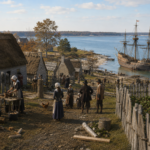
In the first two decades of the 17th century, the Jamestowne Colony in Virginia was struggling. Settled in 1607, the Colony had experienced Indian attacks, famine, disease, and a host of other challenges. Yet, by 1619, the Colony was stabilizing, and with the help of its financial backers at the Virginia Company, many new colonists were being transported to Virginia to help improve the Colony’s fortunes. One of the leaders of the effort to bring economic and social order to the Colony was Sir George Yeardley, who died this day on November 13, 1627.
Born in 1587/88 in Southwark, Yeardley came from the “middling class,” and by the age of 16 he had lost both of his parents. He joined the military, where he rose to the level of Captain of the Guard. The merchant-adventurers who formed the Virginia Company in 1606 must have taken notice of him, because Yeardley was selected to serve as an aide to Sir Thomas Gates, who was appointed the Governor of the Virginia Colony. Together they travelled to Virginia in 1609 on the Sea Venture, one of the ships comprising the so-called “Third Supply,” which famously was shipwrecked off the coast of Bermuda while in transit to Virginia (the story of the shipwreck of the Sea Venture is believed to have been the genesis of Shakespeare’s play, “The Tempest”). Ultimately the survivors of the shipwreck made their way to Jamestown, arriving in the Spring of 1610. With his military experience, Yeardley was put in charge of the soldiers who guarded the town and otherwise maintained order. Over time, he gained the trust and confidence of the people, and in 1616 he was appointed the Deputy Governor of the Colony, and two years later he became the Governor.
As Governor, Yeardley presided over one of the most transformative political events of the 17th century: the creation in 1619 of the Virginia “General Assembly,” the first representative government ever formed in North America. This new government was an outgrowth of the Great Charter of 1618, pursuant to which the Virginia Company had instructed Yeardley to overhaul the system of self-government in the Colony. For his efforts, Yeardley was knighted by King James I. Over the next 8 years, he played a central role in the government of the fledgling Colony.
Yeardley’s tenure as Governor was not without its black marks, at least in retrospect. Most noteworthy, he served as Governor when the first enslaved persons arrived at Jamestown in August 1619 (the same month that the first General Assembly convened). Largely because of this event, many people today point to Jamestown as the origin of slavery in America. Yet, some historians have argued that at least in the years immediately following the arrival of “20 and odd” kidnapped African Americans in 1619, the Virginia Colony’s use of slave labor was relatively modest, and significantly less that the use of white “indentured servants” (some historians say that the number of enslaved persons in the Colony remained flat, or actually decreased, between 1619 and 1625) . Either way, it was Yeardley who served as Governor when slaves were first introduced to the Virginia Colony.
Yeardley’s first tenure as Governor ended in the Fall of 1621, about the same time as several ships arrived from England carrying a group of English “maidens,” sent by the Virginia Company to marry men in the Colony and settle down. This was done with Yeardley’s knowledge and approval, and was a well-publicized effort by the Virginia Company to improve the public image of the Colony. At some level, it was a well-organized publicity stunt. Shortly after the arrival of the “maidens,” the infamous “Massacre of 1622” took place, and a number of the maidens were killed, along with hundreds of other colonists. Yeardley’s departure as Governor in the Fall of 1621 was, in retrospect, well timed—it fell to his successor, Sir Francis Wyatt, to deal with the crisis created by the Massacre.
As for his personal life, Yeardley married Temperance Flowerdew, who came from a relatively well-off family. They had two children by 1618, and although their date of marriage is unclear, they were presumably married before that. Temperance had arrived in Virginia in August 1609, even before her husband. She must have been a strong woman, as she survived the “Starving Time” of the winter of 1609-10. Together, George and Temperance became major landowners, with several plantations comprising thousands of acres. One such plantation was “Flowerdew Plantation,” which Yeardley acquired from the Flowerdew family following his marriage to Temperance. The Plantation still exists, and is listed on the National Register of Historic Places. Temperance outlived her husband by a few years, passing away in 1629. She was briefly remarried to Sir Francis West, who became Deputy Governor of the Colony following Yeardley’s death in 1627. In an ugly development, following Temperance’s death, West went to court against George Yeardley’s children, disputing ownership of his wife’s estate. The children won.
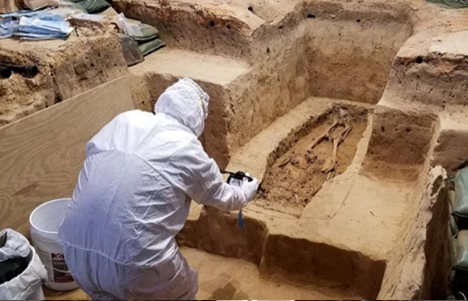
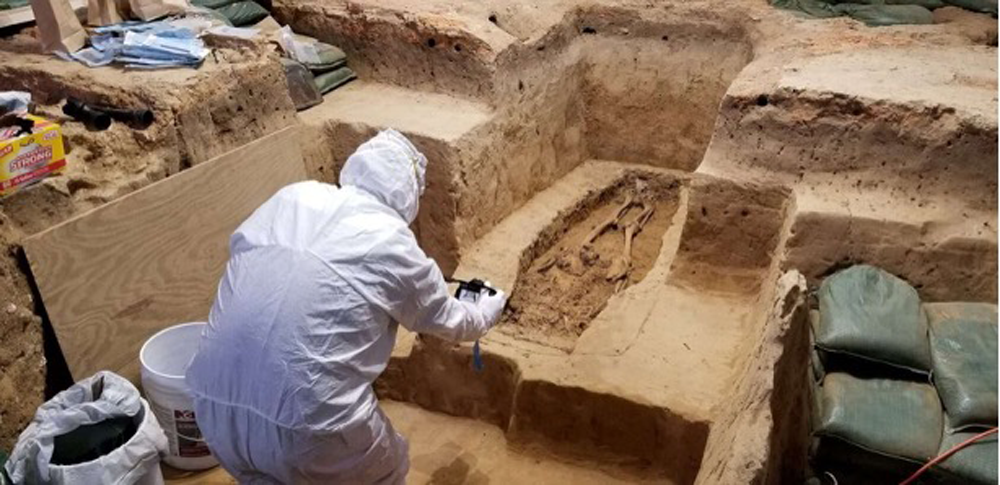
Following the Massacre of 1622, the Virginia Company lost its charter in 1624, and the Colony became an official Crown Colony. Although out of office, Yeardley was well regarded by the Crown, and he was re-installed as Governor in March 1626, replacing Governor Wyatt. His second term of office was cut short, however: he died on November 13, 1627, while still serving as Governor. In 2018, archaeologists at the Jamestown Fort unearthed skeletal remains in the old Jamestown Church which they believe to be the bones of Governor Yeardley (see accompanying photo). A giant granite grave marker was also found in the Church, which is believed to be the grave marker for Governor Yeardley. It has been dubbed “The Knight’s Tombstone.”
And so today we honor the memory of Sir George Yeardley, one of the leading figures in the early history of the Virginia Colony, who left a lasting legacy of representative government in our United States.