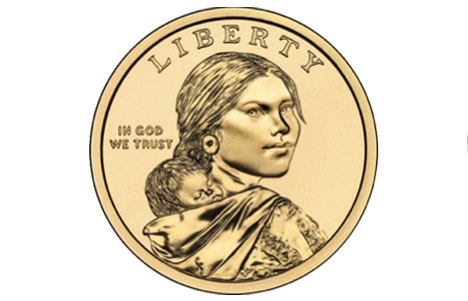
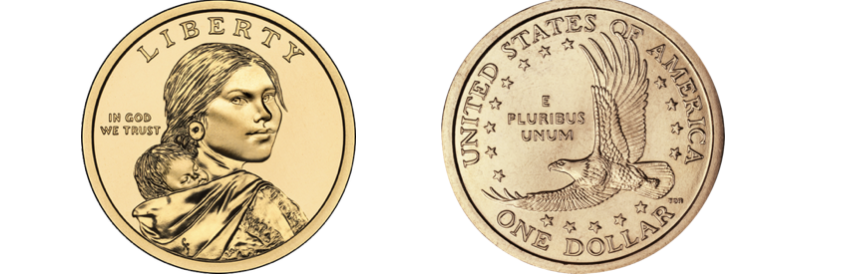
United States $1 commemorative coin honoring Sacajawea, 2000.
A watershed event in American history was the Lewis & Clark Expedition of 1804-06. We’ve posted remembrances before about Meriwether Lewis and his partner, William Clark, the intrepid explorers who led the famous expedition that led to the opening of the American West. Today, we honor a woman who many historians credit as a critical member of the Expedition: Sacagawea, who died on this day on December 20, 1812 at the young age of about 24.
Born in 1788, Sacagawea was a member of the Shoshone tribe, and lived initially in Idaho near the Montana border. In her early teens, she was captured by a rival tribe, then “sold” to a French trapper, Toussaint Charbonneau, who married her (and apparently bought another girl to be his wife as well). In 1804, Lewis and Clark met Charbonneau while wintering at Fort Mandan, and hired him and his wives to join the Expedition as interpreters. In the spring of 1805, the party left Fort Minden, heading west to the Rocky Mountains. Sacagawea quickly proved her worth, as she performed various tasks and rendered assistance to the expeditionary force (while still a teenager!). While en route, the Expedition encountered a Shoshone tribe that—legend has it—included Sacagawea’s brother, Cameahwait, who had become the chief of the tribe. After trading for horses, the Expedition continued west, and began to experience food shortages and other challenges. Sacagawea was instrumental in helping the men find edible foods. She also donated her own beaded belt to use as an item of trade with another tribe they encountered. In general, she was a welcome presence, both to members of the Expedition, and the Native-Americans the Expedition met during the journey; her presence sent a peaceful message to all those they encountered. As William Clark observed, Sacagawea “reconciles all the Indians, as to our friendly intentions… as no woman ever accompanies a war party of Indians in this quarter.”
After completion of the Expedition, Sacagawea and her husband settled in St. Louis, where she raised her two children—later adopted by William Clark. By 1812, Sacagawea was suffering from an unknown illness, perhaps “putrid fever,” according to one witness. In the meantime, Sacagawea’s husband had given full custody of the children to Clark, and the adoption was formalized in August 1813. Some historians dispute whether Sacagawea actually died in 1812, and contend that she abandoned her husband and married a member of the Comanche tribe, but no evidence supports this contention. Certainly, she was dead by the time of Clark’s adoption. Her son, named Jean Baptiste Charbonneau, died in 1866 at the ae of 61. Her place of burial is unconfirmed.
Today, Americans honor Sacagawea in many ways. In 2000, the United States government honored her with the issuance of a beautiful commemorative coin (pictured above). Women’s rights advocate honor her as one of the country’s earliest role models. In the early 1900’s, the National American Woman Suffrage Association erected statues and plaques to honor her. Sacagawea has gone down in history as one of the few female Native-Americans to be so widely memorialized. Over two hundred years after her death in 1812, we honor her today.