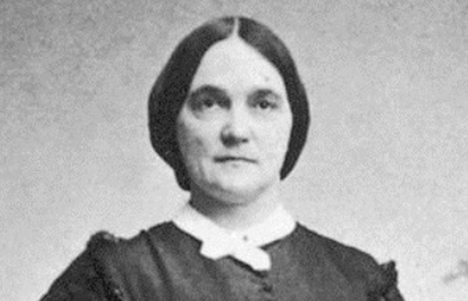
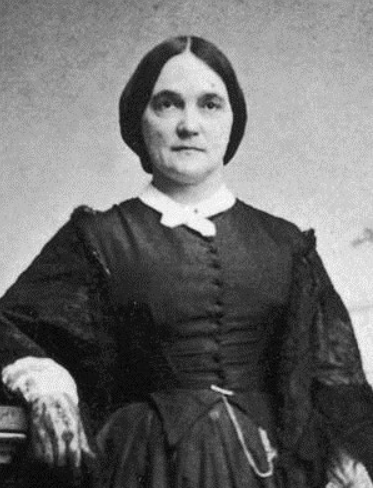
In 1905, one of the most important books about the Civil War was published. Entitled “A Diary From Dixie,” the book was actually the diary of Mary Boykin Chesnut, a Southerner whose first-person account of life in South Carolina during the Civil War is considered by many historians as one of the most revealing narratives about the Southern slaveholder aristocracy as it fought a losing battle to maintain its way of life—and the impact the intransigence of the Southern elites had on the lives of ordinary people. Mary died this day on November 22, 1886 at the age of 63. She worked on turning her diary into a book for several years before her death, but A Diary From Dixie was not published in final form until almost two decades later.
Mary Boykin Miller was born in 1823 at her parents’ plantation in South Carolina. Her father Stephen Miller served in the U.S. House of Representatives, and later became the Governor of South Carolina, reflecting his stature and popularity among members of the planter society in the state. Mary received a first-class education, and was able to speak several foreign languages. At the young age of 13, she met her future husband, James Chestnut, and married him at age 17 in 1840. Like Mary’s father, James was politically connected, and served as a U.S. Senator until the outbreak of the Civil War. As a result of her husband’s political career, Mary became ensconced in the highest circles of Southern society, as well as the social scene in Washington D.C. When the Civil War began, her husband became a General in the Confederate Army, and served as an advisor and close confidante to President Jefferson Davis. Mary was therefore in a rare position to observe the workings of the Confederacy’s military and political establishment up close and personal. Unprompted, she began keeping her diary in February 1861, just two months before the Battle of Fort Sumter in Charleston, South Carolina—the opening salvo of the Civil War. Over the next four years, Mary religiously kept her diary, and wrote about all that she saw and heard. As she put it, “this journal is intended to be entirely objective. My subjective days are over.” She clearly understood—and intended—that her diary be committed to posterity, and read by the general public, not knowing whether the Confederacy would win or lose. Her observations were unvarnished, and portrayed a Southern culture teetering on a precipice, and perhaps destined for collapse. Her commentaries about slavery challenged the conventional wisdom in the South. She was somewhat supportive of the Union cause, and some historians even suggest that she was actually a spy for the North.
Mary Chestnut’s diary has gone down in history, and has served as a primary source for other historians, including C. Vann Woodward, who won a Pulitzer Prize for his annotated edition of the diary, entitled Mary Chestnut’s Civil War. Mary’s diary also figured prominently in Ken Burn’s television documentary, The Civil War. Mary died on November 22, 1886 at her home in Camden, South Carolina, and is buried next to her husband in Knights Hill Cemetery in Camden. Today, her diary can be accessed for free on archive.org.