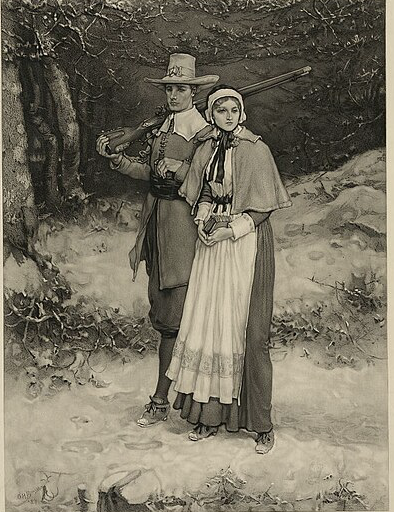
The story of the Mayflower has been a part of American lore for centuries, and each November, we honor the “First Thanksgiving” the Mayflower Pilgrims celebrated at Plymouth Colony in 1621 (although most historians would say that none of the Pilgrims actually called the feast they shared with the Wampanoag tribe on that occasion “Thanksgiving”). Of the 50 or so Mayflower passengers who survived the first winter of 1620-21, there are only a handful whose names are remembered today by the average American. Among the most recognizable names is that of John Alden, made famous by poet Henry Wadsworth Longfellow in his narrative poem, “The Courtship of Miles Standish,” published in 1858. In the poem, Longfellow wrote about a (partly fictional) love triangle between Alden, Miles Standish, and the woman they both loved, Priscilla Mullins; it was Alden who ultimately won her heart, and she became his wife.
In real life, John Alden was an unlikely candidate to become one of Plymouth Colony’s leaders. His background in England is largely unknown, but we know from Governor Bradford’s journal that Alden was a cooper (a make of barrels), and that that was his intended job when he was recruited to travel on the Mayflower to the New World. Unlike the Pilgrims, who were emigrating to America is search of religious freedom, Alden was simply one of the “hired help.” At Plymouth, however, he played an important role in the life of the Colony, and held many positions in the government the of Plymouth Colony. He was one of the “Undertakers” who took over the fortunes of the Colony from a group of English “Adventurers,” and save the Colony from financial ruin. He became one of the Governor’s Assistants, and later served as Deputy Governor. He also served on various committees, and was appointed a magistrate. On the business side, he engaged in the fur trade, and became reasonably wealthy. Wanting more land, he and other colonists established the nearby town of Duxbury, where the foundation of one of Alden’s home still exists, and is a designated historic site.
John and Priscilla are believed to have married in about 1622, and became parents of ten children. Their first child, Mary, was born in 1623. Their son John Alden Jr., born in 1626, became a well-known merchant and trader, and somewhat infamously was one of the people accused of witchcraft during the Salem witch trials (he was never convicted). Alden led an extraordinarily long life, and died peacefully on September 12, 1687 at the age of almost 90 years. When he died, he was the last living man to have signed the famous “Mayflower Compact” in 1620. While his burial site in unknown, a memorial to him was erected at the location where he is believed to be buried. For his dedicated leadership of Plymouth Colony, and for all that he did to establish the first permanent settlement in New England, we honoring his memory today, the 337th anniversary of his death in 1687.