“Robber Barons.” Americans have used this phrase for over a century to describe the late 19thand early 20th century men who were instrumental in the financing of America’s industrial and commercial growth.
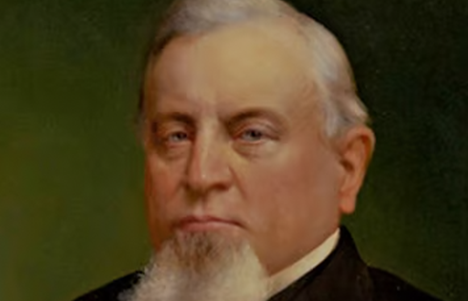
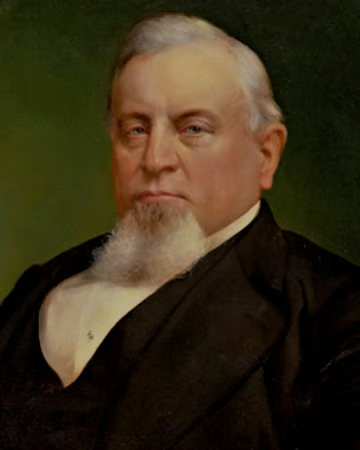
Charles Crocker was born into a family of very modest means, who could never have imagined he would be come only of the wealthiest men in America. As a teenager living in Indiana, he was already working in various trades, and soon he was operating his own iron forge. As was rampant in the mid-1800’s, he moved west to California, where he met and became business partners with the other three members of the Big Four. Together they formed the Central Pacific Railroad, which in the 1860’s commenced the effort to build a railroad from Sacramento over the Sierra mountains, across the Nevada desert, and into the Utah territory. This project ran in parallel with the same effort being undertaken by the Union Pacific,
A rival, but both companies having the shared interest of connecting the mid-west with the Pacific.
Charles Crocker’s role in connection with the business of the Central Pacific Railroad was to serve as the construction supervisor, and to head up a Central Pacific subsidiary, Charles Crocker Co., that would do the actual building of the transcontinental railroad. The construction effort was prodigious. The work began in 1863, but was not completed until May 1869, when the famous “Golden Spike” joined together the tracks laid by the Central Pacific and the Union Pacific at a meeting point in Promontory Utah. Over those six years, the construction crews had to overcome seemingly insurmountable hurdles. Historians credit Crocker and his associates for their masterful job of laying tracks where no one imagined they could run, as well documented in Stephen Ambrose’s book, “Nothing Like It In the World.”
While the Central Pacific’s project was underway, Crocker branched out, believing that there would be massive financial rewards if he and his associates could corner the market for other rail lines running to and through the Southwest. Towards that end he acquired control of the Southern Pacific Railroad, a company that ultimately was successful in building a second continental railroad that ran to Southern California. Related to all of this, Crocker also became heavily involved in the banking business, at one point becoming the controlling shareholder and President of Wells Fargo Bank. The story of the financing of these building projects—and the corruption that often accompanied it—can be found in Richard White’s superb book, “Railroaded: the Transcontinentals and the Making of Modern America.”
After an illustrious and controversial business career, Crocker died in 1888 at the age of 65, a result of a carriage accident in 1886 in which he was seriously injured. He is buried in Mountain View Cemetery in Oakland, California.
And so today we honor the memory of Charles Crocker, born 203 years ago today.