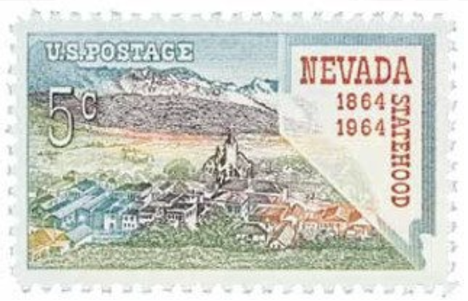
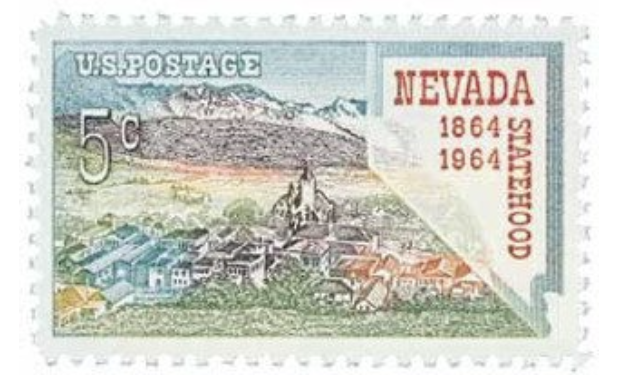
On October 31, 1864, President Abraham Lincoln officially announced the admission of Nevada to statehood. On that day, Nevada became the 36th state in the Union, as the country was still in the midst of the Civil War, and Lincoln was seeking re-election to a second term as President. The timing of Nevada’s admission was momentous.
The sequence of events leading to Nevada’s statehood reflects Nevada’s growing importance to political leaders in Washington D.C., who had been dealing with the challenges of Western expansion—and slavery—for decades. Just as the Southern states saw the West as fertile territory for the expansion of slavery, Northerners saw the settlement of the West as a political battleground over the future of slavery in the United States. California had achieved statehood in 1850, but neighboring Nevada was trailing far behind, both in population and economic activity. After the Mexican-American War ended, the Utah Territory was created in 1850, which included what is now Nevada. Still, the people of Nevada were few in number, and an entire decade passed before the state began to prosper. When silver was discovered at the Comstock Lode in Virginia City in 1859, suddenly Nevada’s population exploded, and its economy boomed. Seeing this, Congress created the Nevada Territory in 1861, and the people of Nevada were now in a position to seek statehood.
In order to be admitted to statehood, the Territorial government needed to enact a state constitution and have it ratified by the voters in the state. That happened on September 7, 1864, as voters overwhelmingly approved the proposed constitution. The voting results were immediately telegraphed back to Washington, D.C, and Lincoln announced Nevada’s statehood on October 31.

[Pictured: page 1 of the long telegraph sent to President Lincoln on October 31, 1864]
The timing was propitious for Lincoln and the Republican party: now, Nevada’s three electoral votes could be counted in the November election on November 7, 1864, and Nevada’s electors reliably voted for Lincoln. Without those electoral votes, Lincoln feared he would lose the election, or the election would be thrown into the House of Representatives, where it was uncertain that Lincoln could gain the support of a majority of the congressmen. But with Nevada’s help, Lincoln was re-elected, and the rest is history.Nevada’s newly-enacted constitution also assured that Nevada would be a non-slave state, and that it would support the Union in the Civil War. With some horse-trading (including a shady deal with mine operators in order to ensure their support), Nevada’s Republican party had gotten the job done.
Today, the “Battle Born State” is politically divided, like so many states in the Union. But we stop for a moment to honor those political leaders whose hard work and dedication allowed Nevada to gain statehood 160 years ago today, and who helped the Union achieve success in the Civil War.