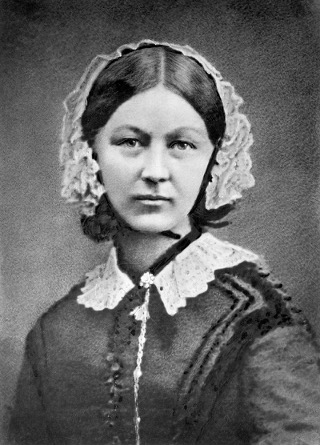
On August 13, 1910, one of the pioneering women in the field of medicine and medical practices passed away. Florence Nightingale is considered to be the founder of modern nursing, and her work heavily influenced American healthcare and medical practices. At the height of her career in the mid-1800’s she is credited with having introduced various hygiene, nutrition, sanitary and living standards that helped save lives, which she developed in real time as she tended to wounded soldiers on the battlefields of Europe. Some of her innovations are taken for granted today, such as the simple act of handwashing, yet they were non-existent before she led the effort to improve the conditions under which doctors treated their patients, and how patients were cared for in general. Later in her career, she introduced ways to professionalize the nursing profession, and established a nursing school that still operates today at King’s College in London as the “Florence Nightingale School of Nursing and Midwifery.”
Florence was born in 1820 to William and Frances Nightingale, wealthy parents who were then living in Florence, Italy—hence their naming of their daughter “Florence.” A year after Florence was born, the family moved back to England. William Nightingale was a strong advocate for women’s education, and so Florence received a first-class education. Florence also was mentored by various older female role models along the way, but she apparently preferred men as role models and colleagues, at one point claiming that women were not as capable as men, and that they failed to take advantage of job opportunities in the medical profession when they became available. Whatever her views about women, Florence was successful both in creating nursing schools for women, and helping advance their careers in medicine.
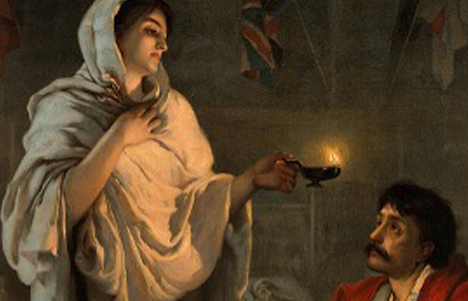
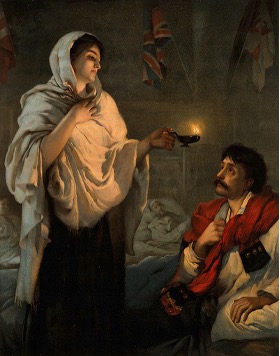
Florence gained her nursing experience primarily in theatres of war, most famously during her time spent tending to wounded soldiers during the Crimean War (1853-56). There, she witnessed the massive death rates that often took place for lack of critical nursing care. At Scutari in Albania, over 4,000 soldiers died, many of them from infectious diseases, not from wounds on the battlefield. Florence concluded that many deaths could have been avoided by better living conditions, and when she returned to England she began analyzing data and generating statistics to prove her point. Her work during the Crimean War was widely praised, and she became known by various flattering names: the “ministering angel,” the “lady with the lamp,” and so forth. In 1857, American poet Henry Wadsworth Longfellow honored her with these poetic words:
“Lo! In that house of misery/ A lady with a lamp I see/
Pass through the glimmering gloom/ and flit from room to room”
It was during the Crimean War that Florence’s work led to the creation of the Nightingale Fund, which was dedicated to training nurses, and which raised over 45,000 pounds (over $5 million in today’s U.S. dollars) to fund nursing schools. The first such school was established in mid-1860, and soon a number of nurses who trained there entered the field. Some of these nursed worked in poorhouses in England, which previously lacked any semblance of nursing care. Some of the nurses trained at her schools went on to become leaders in the field, and oversaw nursing care at a number of prominent hospitals.
Besides the hands-on nursing work she did over the course of several decades, Florence was also an accomplished author. Among her books and other writings are The Institution of Kaiserswerth on the Rhine (her first work, published in 1851), and Notes on Nursing (1859), which became one of the seminal texts on the nursing profession. Although Florence never visited America, she had a profound impact on nursing practices in this country, particularly during the American Civil War, during which Union Army representatives contacted her seeking advice on how to better care for wounded soldiers on the battlefield. Based in part on her inputs, in 1861 the Union Army created the United States Sanitary Commission, which was partly modeled after the British Sanitary Commission created during the Crimean War. Among the nurses who worked for the Commission was none other than author Louisa May Alcott. The Commission was dissolved in 1866, following the end of the Civil War in 1865. A history of the Commission’s work was published the same year.
Despite all her accomplishments, some historians argue that the value of her contributions has been over-stated. She also is said to have had denied the idea that some ailments were the result of infections, but modern historians have debunked this criticism. Her accomplishments led to her being awarded the Royal Red Cross in 1883, and she was the first female recipient of the Order of Merit. Most prominently, her birthday is recognized today as the International May 12 Awareness Day. Florence lived a long life, passing away on August 19, 1910 at the age of 90. She is buried in a quiet churchyard, with a gravestone that carries only her initials and her dates of birth and death.
So today we honor the memory of Florence Nightingale, a woman whose pioneering work has helped save lives throughout the world.