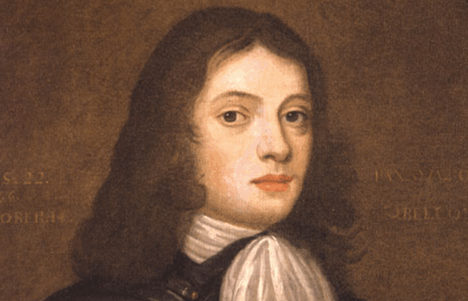
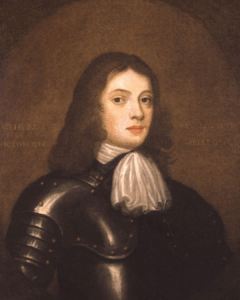
 He is the namesake of one of America’s original thirteen colonies. A university is named after him, as are numerous high schools, streets, parks and monuments. One of New York City’s major train stations bears his name. But today the actual person is barely remembered, let alone honored. So today, we want to take a moment to pay our respects to a major figure in our early American history: William Penn, who died this day on July 30, 1718.
Born in 1644 in London, William Penn was the son of a distinguished naval officer, Sir William Penn Sr., and his Dutch wife Margaret Jasper. During William Jr.’s childhood in London, England experienced massive religious strife, with the Puritans led by Oliver Cromwell mounting a rebellion against the reigning monarch, King Chares I, who ultimately was overthrown and beheaded in 1649. During the ensuing period of Cromwellian rule, the so-called “Interregnum,” William and his family were forced to flee to Ireland.
William’s Conversion to Quakerism, and His Radicalization
It was in Ireland that William was first exposed to the Religious Society of Friends, otherwise known as Quakerism. It did not take long for William to become a staunch adherent to the Quaker faith. In college at Oxford, William was a witness to the religious conflicts between Puritans, Quakers and “Cavaliers” (supporters of the monarchy), and historians believe that William was a quiet supporter of the Quakers.
Meanwhile, William’s father, an Admiral by then, had become a close confident of King Charles II, who returned to England from exile after the death of Oliver Cromwell. In fact, it was Admiral Penn who has been sent from England to the Continent in 1660 to retrieve the exiled King and bring him home. William’s father was so highly regarded that at King Charles’ coronation ceremony, the King saluted the Admiral for all that he had done. The Admiral subsequently was knighted by the King, and appointed to serve as the Lord Commissioner of the Admiralty. This powerful position would prove to be instrumental to William’s later role as the Proprietor of the Colony of Pennsylvania. Yet, while in college, William’s growing affinity for the Quaker faith put him at odds with his father, who was a Cavalier to the core.
Ultimately, William was expelled from Oxford for his religious non-conformism, causing his father to beat him with a cane and send him away from the family home. By 1662 William was living in France, where he spent the next two years refining his religious beliefs, and adhering to a more humanistic theology than the rigid theology of his parents. In 1666 William was back in Ireland, where he saw the increasing persecution of Quakers first hand, due in no small part to new restrictions on religious dissent imposed by the King—his father’s benefactor. That same year William declared himself to be a Quaker, and was jailed. Although later released, William became a liability for his father, who banished him from the home.
In 1668 William published his first significant religious tract, “Truth Exalted: To Princes, Priests and People,” in which he slammed the Church of England and Puritans, while labeling the Catholic Church the “Whore of Babylon.” For this he was quickly jailed and imprisoned in the Tower of London. In 1669 he authored another incendiary tract, “No Cross No Crown,” which he wrote while still in the Tower. Despite knowing that he once again had crossed the line, William declared “my prison shall be my grave before I will budge a jot: for I owe my conscience to no mortal man.” Miraculously, he was released from prison after only eight months, but William was not penitent—he continued to attack the Church, and was arrested again in 1670. Another miracle: in his subsequent trial, the jury found him not guilty of heresy, as result of which the Court jailed the jurors! William’s father then intervened and obtained his son’s release from prison.
William Founds the Colony of Pennsylvania
During the 1670’s William’s activism intensified. By 1677, William and a group of prominent Quakers were able to negotiate the purchase of the North American province of West Jersey, essentially the western half of present-day New Jersey. This was followed by Penn’s successful petition to the King for a charter to over 45,000 square miles of land west of New Jersey and north of Maryland. This new charter, signed by the King in 1681, made Penn the sole proprietor of the colony variously called “New Wales” or “Sylvania.” Soon it would be called Pennsylvania— actually named by King Charles II in honor of William’s father the Admiral. With charter in hand, William traveled to his new land and negotiated agreements with the Lenape tribe, followed by his issuance of a “Charter of Liberties” for the Europeans who would become the first settlers of Pennsylvania. William called it his “Holy Experiment.”
Pennsylvania Grows and Prospers; Quakerism Expands, and Religious Tolerance Takes Root
In the early years of the Colony, William allocated some 300,000 acres of land to the first 250 settlers, mostly Quakers from England. At the same time, he worked to establish a government structure, with various rules and regulations—but not a democracy by any stretch—William remained the sole proprietor who could impose his will if he so chose—or simply ignore the demands of his people, or neglect administrative matters that needed tending to. His inattentiveness and sloppiness ultimately led to push-back from the colonists, who wanted more local control and autonomy. William’s physical absence didn’t help matters– he remained in England for the better part of two decades, ruling from afar, until circumstances dictated his return to America in 1699.
In the interim, in 1685 King Charles died, and his brother James II, a Catholic, took the throne. Thankfully, James was tolerant of Quakerism, which enabled William to continue to receive support from the Crown for his endeavors in Pennsylvania. Among other things, William welcomed settlers to his Colony who were not Quakers, including French Huguenots, Mennonites, Amish and Jews. He also advocated for better treatment of slaves (but stopped short of abolishing slavery, since William himself was a slaveholder).
William’s Return to England in 1701; Financial Woes Catch Up with Him; He Dies Penniless in 1718
Largely at the behest of his wife Hannah, William decided to return to England in 1701. The family immediately experienced various setbacks, including financial problems caused by William’s money-losing financial support of his Colony in America, as well as the profligate spending of his oldest son. The family also suffered losses due to the financial shenanigans of William’s financial advisor, who cheated his employer in various ways over a period of years. His crimes went undetected until it was too late. Desperate to salvage things, William twice attempted to sell Pennsylvania back to the Crown. The second time was in 1712, but the effort was suspended when William suffered the first of two strokes that left him unable to speak. Soon, he suffered from memory loss, and was unable to care for himself. He survived a few more years, but tragically died penniless in 1718, at the age of 73.
William’s Legacy
Upon his death, William left a large family. With his two wives he fathered seventeen children, almost all of whom survived to adulthood. William’s second wife Hannah outlived him by eight years, passing away in 1726; she served as the Proprietor of Pennsylvania during those eight years, a testament to her intelligence and fortitude.
Of course, William’s most important legacy was the foundation he laid for Quakerism in America, and religious freedom in general. While Quakers continued to be persecuted in Europe and America during the 18th century, the Pennsylvania Colony that William founded created a safe haven for Quakers everywhere, thanks to William’s leadership and perseverance. During the rest of the 18th Century, a number of Quakers ended up playing prominent roles in American politics and culture. So today, we honor the memory of this major figure in our American history, who died this day on July 30, 1718.