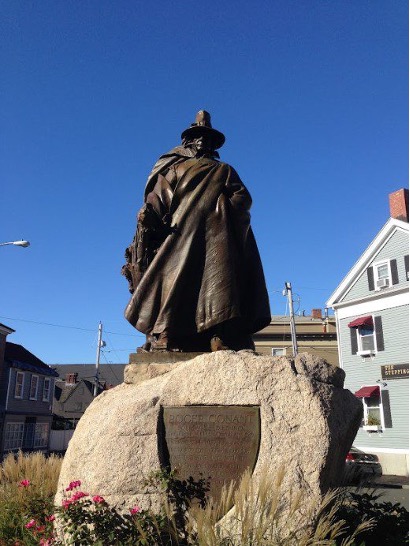
Most everyone in America today associates the city of Salem, Massachusetts with the infamous Salem Witch Trials, which took place in the year 1692. But I invite you to travel back even further in time, almost seventy years, to the year 1624, when a man named Roger Conant arrived in New England, and took up residence in Plymouth Colony. He did not stay long, as he became embroiled in a dispute with the Colony’s leaders over issues of religion: Conant saw Plymouth as too intolerant, and he quickly became a religious dissident, and left Plymouth for a more hospitable place to live and worship. Soon he found his way to Cape Ann, north of Plymouth, in the area of today’s Gloucester, Massachusetts. There he established a trading post and engaged in the trade he practiced back in England, a “drysalter,” an important job to the fishing industry in preserving fish.
By 1626, Conant had been chosen to serve as the first Governor of the settlement at Cape Ann. Historians say that this was the first permanent English settlement in what was to become the Massachusetts Bay Colony. In just a few years, Conant was replaced by John Endacott, and Conant headed to an area known by the Indian name “Nahum Keike”—later to be known as Salem—and established a settlement there in 1626. He built the first house there, and became a member of the Bay Colony, serving as a representative for Salem in the Bay Colony government. Indeed, he held many different posts over the course of the next four decades, and had a hand in most every aspect of the town’s development. This year Salem celebrates the 400th anniversary of the founding of Salem (more information about Salem’s anniversary festivities is available of the Salem 400+ website).
During Conant’s time at Cape Ann, he was involved in one incident that has gone down in history. In 1625, he and other settlers concluded that the settlement at Cape Ann needed to move, to avoid the threat of “bloodshed between two factions contending for a fishing stage.” As it turned out, one faction was the Plymouth Colony, led by Myles Standish. The two factions confronted each other, with Standish threatening violence in a physical standoff with Conant. The standoff was resolved, but Conant was deeply shaken by what he had witnessed. Yet, he had not shied away from the confrontation, and he saved his settlement from a “hostile takeover” by Standish and his men. The following year is when he was chosen to serve as Governor.
During this period of hard living and hard times, Conant managed to raise a large family. He and his wife Sarah (married in London in 1618) had nine or ten children between 1619 and 1637. Roger lived a long life, dying in Beverly Massachusetts on November 19, 1679 at the age of 87. His wife Sarah appears to have pre-deceased him. Conant is believed to be buried at Burying Point Cemetery in Salem, although this is unconfirmed.
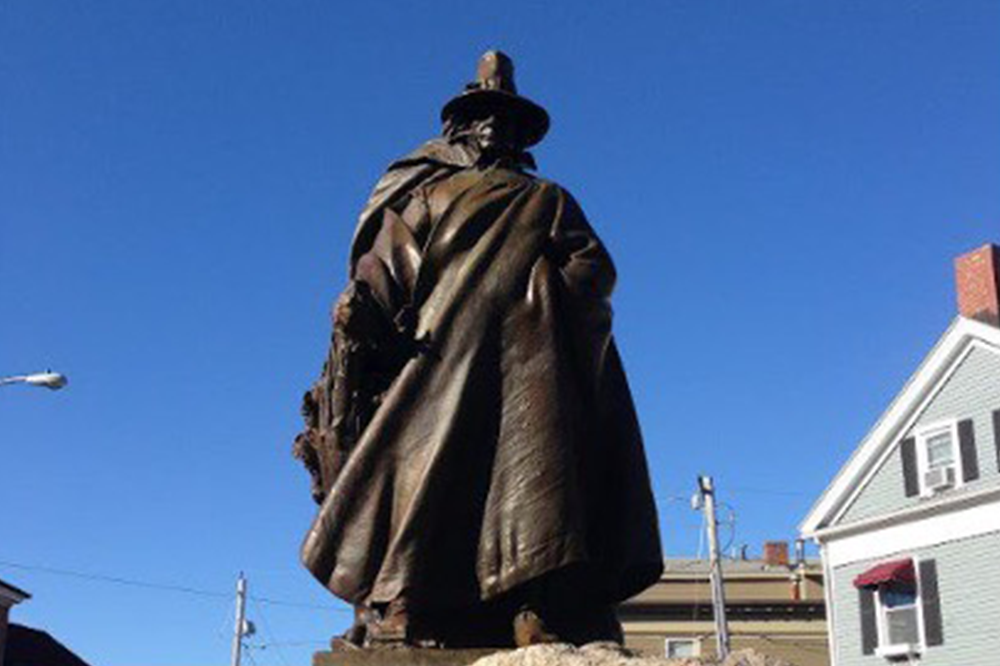
So today we honor the memory of Roger Conant, who was born this day on April 9, 1592. He was a key figure in the history of the Massachusetts Bay Colony, and was a role model for others who advocated for greater religious tolerance in the emerging settlements of New England in the early 17th century. Visitors to Salem will see an impressive statue of Conant in the middle of the city commemorating his life—a testament to the important role he played in the life and culture in the settlement that was to become the center of government of the Bay Colony in its first few years.