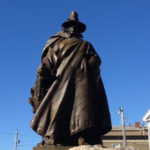

Most Americans who know much of anything about the Mayflower and Plymouth Colony remember at least two key events: the signing of the Mayflower Compact when the Pilgrims first arrived in Plymouth in 1620, and the “First Thanksgiving” the following year. Some people also will remember the name William Bradford, the Colony’s Governor who kept a detailed written record of the first several decades of the Colony’s existence, later published as “On Plymouth Plantation.” But who remembers the name John Carver, the first Governor of Plymouth Colony? Not many. So this month we want to provide a brief history of one of the most important men in the history of the Mayflower, who died this month in the year 1621.
Like a number of the “Separatists” who journeyed to New England on the Mayflower, John Carver was an Englishman who had made his way to Leiden in the Netherlands, where he joined the Separatist congregation there led by Reverend John Robinson. But unlike most members of the congregation, Carver had accumulated a heathy fortune before leaving England, and owned significant amounts of land in his native Suffolk County. He did not keep his wealth to himself, however: he liquidated most of his land holdings in order to fund the Separatists’ move to the Netherlands, and their years of hard living there in the period 1608 to 1620. The date of Carver’s arrival in the Netherlands is unclear, but he and his second wife Katherine White were there by 1615. He was already middle aged: born in about 1580, he would be 35 years old when his name first appears in Leiden records.
When the Separatist congregation began discussions about moving to the New World, Carver was deputized to travel back to England to obtain the financing for the venture. He and a fellow Separatist, Robert Cushman, went to London in 1617 and commenced negotiations with the Virginia Company to fund the establishment of the Colony. Naturally, the deal would necessarily involve a return on investment to the men who were going to put up money for the ship, the provisions, and all the other necessary costs of sending over 100 passengers to North America.
After some hard-bargaining, a group of “Merchant Adventurers” led by Thomas Weston struck a deal with Carver and Cushman, which would fund the cost of two ships, the Mayflower and the Speedwell, traveling to an as-yet-unspecified location in North America, somewhere north of the area already settled by England in Virginia, the Jamestowne Colony. As is turned out, only the Mayflower left port, and Carver was on that ship with his wife Katherine. It was a long and challenging Atlantic crossing, but they made it to Cape Cod, where the ship dropped anchor near today’s Provincetown. It was there that the Mayflower Compact was signed on November 11, 1620, and Carver’s was the very first signature on the document—a testament to his importance to the Separatist congregation on board (some historians have suggested that Carver was actually the author of the Compact, but there is no direct evidence of that).
The rest of the story of Carver’s time in Plymouth is a tragic one. He and his wife both died in in the first few months, Carver in April and his wife shortly thereafter. Carver had been named Governor of the Colony, and his death left a vacancy that was immediately filled by William Bradford. Before he died, Carver did one massively important thing: he negotiated a peace treaty of sorts with the neighboring Indian tribe, led by Massasoit. While it was not a lasting peace, it allowed the Plymouth Colony to take root, and for that we must thank Carver for his efforts. It was just a few weeks later that he died, at the age of about 64.
William Bradford gave high praise to Carver in his “On Plymouth Plantation.” About his death, Bradford wrote:
“His death was much lamented and caused great heaviness amongst them, as there was cause. He was buried in the best manner they could.”
A number of the Mayflower passengers who survived the first winter of 1620-21 went on to have large families, and today there are millions of descendants of those Pilgrims. In John Carver’s case, he had only one known child by his first wife, named Margaret, born in 1603 in England. According to Robert Charles Anderson in his book The Mayflower Migration, there is no record of Margaret’s life after 1604, and there are no known descendants.
So today we honor the memory of John Carver, the Pilgrim whose tireless efforts were instrumental in the establishment of Plymouth Colony.