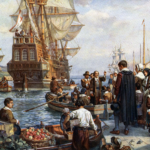
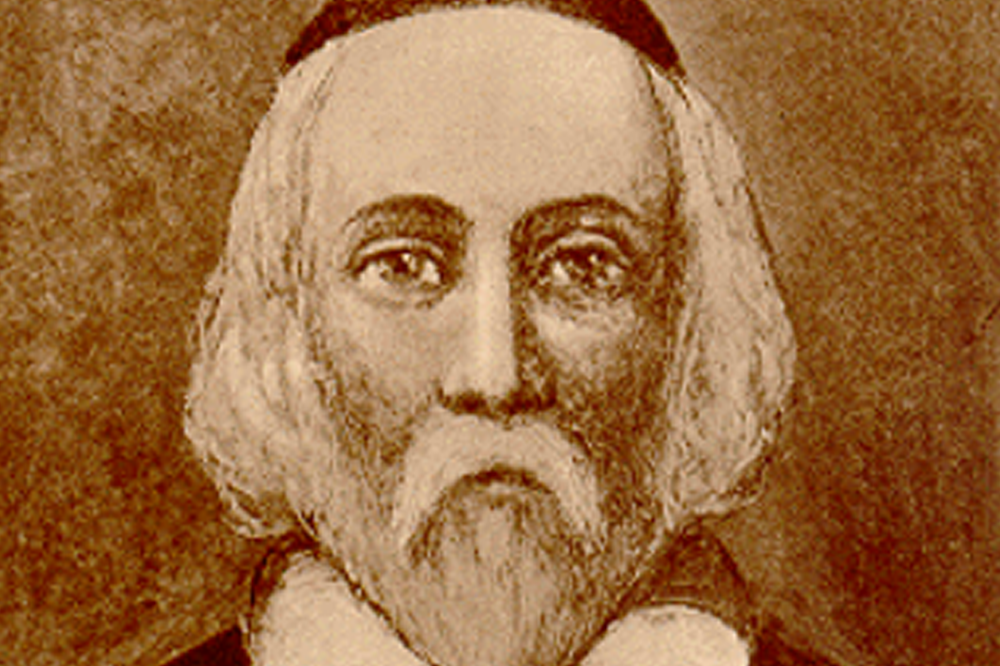
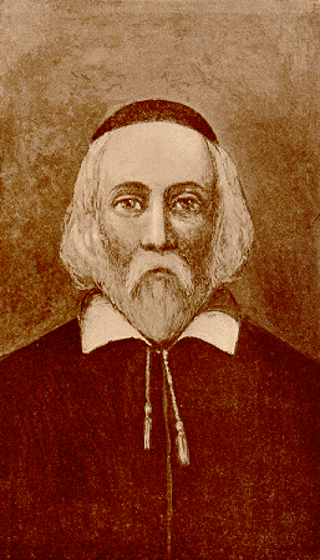
One of the most important passengers on the Mayflower in the year 1620 was William Brewster, who died this day on April 10, 1644. He was one of the original “Separatists” from Northern England who, in the early 1600’s, migrated to the Netherlands seeking religious freedom. The English Separatists remained there for roughly a dozen years, and formed a close-knit congregation under the leadership of Reverend John Robinson. They were outsiders, however, and over time, life in the Netherlands wore on them, so they decided to move to North America. There, they established Plymouth Colony, and the rest is history.
A short summary of Brewster’s years before the Separatists moved to the Netherlands sheds light on how sophisticated this man was, and how he achieved such standing within the Separatist congregation. Brewster came from a family of modest means, growing up in Nottinghamshire and receiving a few years of schooling. According to Governor William Bradford, writing in his famous “Of Plymouth Plantation,” Brewster attended Cambridge University in 1580 (but did not graduate). Along the way he learned both Latin and Greek. In 1583, Brewster became a servant to William Davison, Secretary to Queen Elizabeth I who served as her roving ambassador. Brewster travelled with Davison to various European countries, assisting him in his various diplomatic missions. In 1585-86, Brewster accompanied Davison on a critical diplomatic mission to Amsterdam and Brielle in the Netherlands, where he met and got to know several political leaders in the Netherlands. At the time, Brewster would have been only about 19 or 20 years old, but by then he was performing more as a diplomatic aide than a servant. William Bradford later wrote that Davison had found Brewster “so discreet and faithful [that] he trusted him above all others that were about him, and only employed him in all matters of greatest trust and secrecy.”
Over the years, Brewster formed a strong relationship with Davison. Bradford wrote that Davison “esteemed him rather as a son than as a servant,” and that Davison “in private would converse with [Brewster] more like a friend and familiar than a master.” Clearly Davison was an important mentor to Brewster, from whom Brewster learned the ways of diplomacy and the ways of Court.
In 1587, Davison’s standing at Court changed radically, due to his central role in the trial and execution of Queen Elizabeth’s cousin, Mary Queen of Scots. It was Davison who carried Mary’s death warrant to the Queen for her signature, but the Queen later blamed Davison for having allowed the execution to be carried out without her final order. For this perceived transgression, Davison’s career was ruined. Throughout Davison’s travails, Brewster “remained with [Davison] till his troubles… and some good time after, doing him many faithful offices of service in the time of his troubles.” Davison’s unfair treatment has caused some historians to say that he was a “scapegoat,” so that the Queen could not be accused of executing her own cousin!
Following Davison’s fall from grace, Brewster returned to Nottinghamshire, where he took on the job of postmaster for his village of Scrooby. It was about this time, maybe @ 1598, that Brewster, following his parents’ example, became involved in the Reformed Protestant Separatist movement, which advocated a complete split from the Church of England (hence the name “Separatist”). Under Queen Elizabeth I, who reigned until 1603, Separatists were persecuted, and their church leaders barred from preaching in Church of England churches. Brewster was among the Scrooby Separatists who practiced their faith in secret, out of fear of persecution. William Bradford wrote that after the Scooby congregation “joined together in communion, [Brewster] was a special stay and help unto them. They ordinarily met at his house on the Lord’s Day… and with great love he entertained them when they came.”
When Elizbeth died in 1603, her successor, King James I, was similarly opposed to the Separatist movement. It was Brewster who organized the flight to Holland, which required some stealth, since it was illegal to leave the country without the King’s permission. On their first try, they were captured, and Brewster was imprisoned. As Bradford described it, Brewster “was the chief of those that were taken in Boston [the port], who suffered the greatest loss, and of the seven that were kept [captured], longest in prison.” He was released, and on the second attempt he and his fellow Separatists were successful, and found their way to Amsterdam. This would have been in the year 1608, by which time he had a wife and four children.
Why the Netherlands? The country was considered a welcoming place for religious non-conformists, Reformed Protestants in particular (some of whom were already there before Brewster arrived). For the most part, government officials in the Netherlands left them alone. But life in the Netherlands was quite different for Brewster, especially after the illustrious life he had led in England as an aide to William Davison. As Brewster put it, “in regard to [Brewster’s] former breeding and course of life, [he] was not so fit for many employments as others were, especially such as were toilsome and laborious.” Yet, Brewster and his family persevered.
Soon after Brewster and his fellow the Separatist came to Amsterdam, the congregants in the Separatist church there came to disagree on certain doctrinal matters, so Brewster & company decided to leave Amsterdam and move to the city of Leiden. What ensued when Brewster arrived in Leiden was a story of courage and perseverance. Brewster took on several jobs, including serving as a teacher of college students at Leiden University, and– most relevant to the critical role Brewster played in the Separatist cause—a printer. Other members of the congregation became employed in a wide variety of jobs, most of them at the lower end of the pay scale, in part because they did not belong to any of the local guilds (which would not hire them). As well, there were language and cultural barriers, and as Governor William Bradford later wrote, the Separatists’ children were turning Dutch, and they did not want that to happen.
Brewster’s years in Leiden were increasingly treacherous after he became one of the handful of men who were willing to print religious tracts that challenged the orthodoxy of the Church of England. These tracts were usually anonymous, and were smuggled into England. Brewster was a “go to” person for these printing jobs, and he operated a secret printing business on a back alley in Leiden (which can still be visited today). By 1617, English authorities had identified him as an enemy of the State, and English spies were sent over to Leiden to try to catch him, to no avail: Brewster was always one step ahead of them (he is said to have been hiding somewhere in Leiden, and later perhaps back in England). In 1617, he “outed” himself by publishing a tract which had his name on it—an act of treason, if he was ever caught. Yet he was able to remain free, and continued his clandestine printing business.
When the Pilgrims decided to leave for America, the leave-taking was a difficult one, since not all of the Leiden Separatists were going to make the journey, and in some cases the men were leaving their wives and children behind (as it turned out, some of the emigrants would never see their wives or children again). The Pilgrims also left their pastor John Robinson behind. He was supposed to join them, but he died in 1625, and never made it to Plymouth.
In Plymouth, Brewster was one of the most respected leaders of the Colony. Among other honorifics, he served as the settlers’ church elder, and led their worship services for a time (they had no minister at first). In 1626-27, he was one of the handful of colonists who became “Purchasers” in a major transaction by which the Colony took over the assets and liabilities of the Colony from the Merchant Adventurers who had funded the establishment of Plymouth Colony. He also served as a key advisor to Governor Bradford. In all of these roles, he was viewed as fair-minded and even-handed.
Over the years, Brewster became one of the wealthier members of the Colony. In 1632 he acquired land in Duxbury and moved there. Two of his daughters, Patience and Fear, married other leaders of the Colony. A sign of Brewster’s relative wealth can be found in the inventory of Brewster’s estate after his death in March 1644. The inventory can be found on the website of the Plimoth-Patuxet Museum, and is many pages long. By the time of his death Brewster had amassed a large collection of books, dozens of them in Latin. He also had many items of clothing, some of which were quite fancy and colorful (“three waistcoats;” “1 pair of green drawers;” “1 red cap;” “2 pairs of gloves;” “1 pair of garters;” “3 handkerchiefs;” “1 pair of black silk stockings;” “1 green waistcoat;” etc., etc.). Also listed are many bedroom items (a number of blankets and canvas sheets; “1 pair fine sheets;” a “feather bed bolster & pillows;” etc., etc.). Of course, there were many utilitarian items and pieces of furniture as well (a pistol, several swords, a dagger; various tools, kitchenware, etc.). Among the furniture was “1 chest,” very possibly the chest shown in the photo below, which Brewster had brought with him on the Mayflower, and which is on display at the Plimoth-Patuxet Museum: