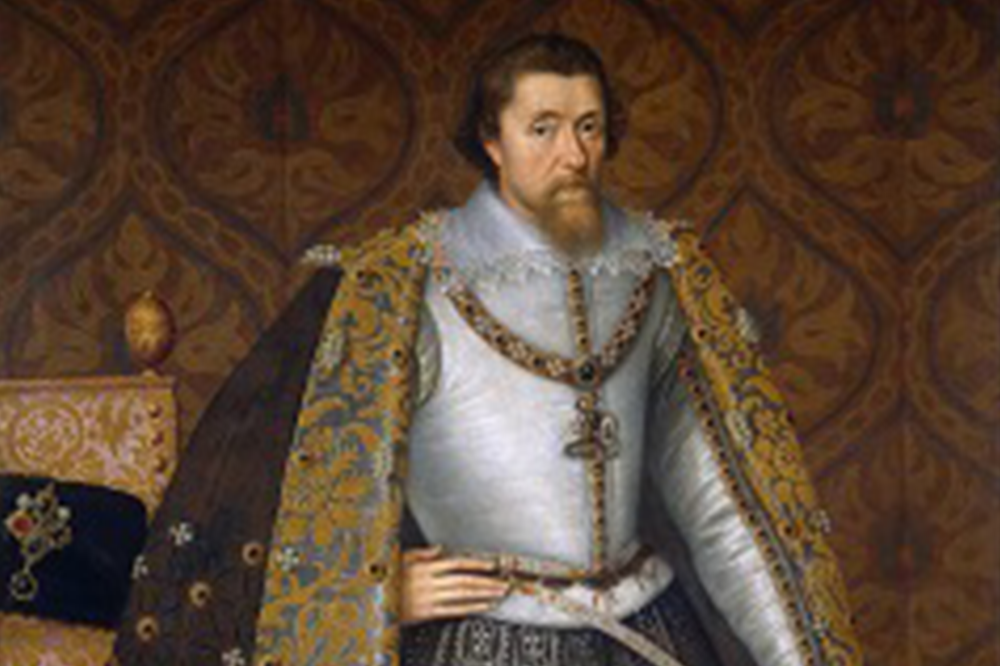
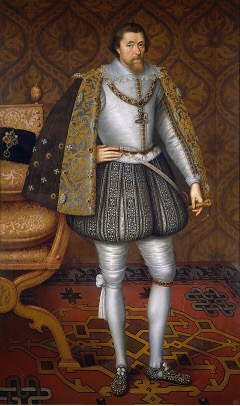
One of the most important supporters of early American colonization was King James I of England, who died this day on March 27, 1625. We honor him today for all that he did to promote the earliest English settlements in North America, and to oversee the development of thriving English colonies in New England, Virginia, and elsewhere.
King James’ life story is an interesting and colorful one. Before he was King of England, he was already the King of Scotland, having been crowned as King James VI of Scotland in 1567 after the abdication of his mother, Mary, Queen of Scots. James was only one year old at the time, and as was customary in medieval times, he had “regents” assigned to him who basically ruled the country until James reached the age of maturity. Most prominent in his early life story is the sordid tale of his mother Mary Queen of Scots, who was executed in 1587 by Queen Elizabeth, after being held captive from 1568 until her death almost two decades later. Queen Mary was loved by her Catholic supporters, but hated by many, who accused her of a wide range of personal and political transgressions that led to her downfall. Mary spent hardly any time with her son James before she abdicated the throne and went into exile, then captivity in England. Ironically, perhaps, Mary was a devout Catholic, and much of her political problems arose from her Catholicism—but James was raised to be a Protestant, and he was known to persecute Catholics during his reign as King of England, Scotland and Ireland. James was committed to his faith, and is most often remembered today as the namesake of the King James Bible.
Besides the political controversies that swirled around King James in his early years as King of Scotland, his ascension to the throne in England in 1603 was fraught with political controversies as well, and it was not by any means a forgone conclusion that he would be crowned King of England. He faced multiple challenges to his kingship. First and foremost, perhaps, he was Scottish, which was anathema to many Englishmen. Second, he was the son of the Catholic Queen Mary (who was dead by the time James became the English King), and it was feared that he might re-establish the Catholic faith in England if he became King. Third, his predecessor to the throne, Queen Elizabeth, had refused to name her successor before her death, and there were at least half a dozen candidates to succeed her besides James. Who knew whether James would defeat his rivals for the Crown? Lastly, Queen Elizabeth’s death represented the end of the Tudor dynasty, as Elizabeth had died childless, and there was no structure in place to deal with the possibility of a non-hereditary King. All of these factors might have led to chaos in the transition from the Tudor dynasty to the Stuart dynasty. And yet, the transition was almost entirely peaceful, to the surprise of many members of Queen Elizabeth’s Court.
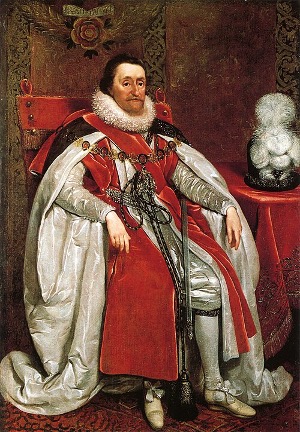
Turning to the real purpose of this article, we address below the two major American colonial settlements that occurred during the reign of King James: The Jamestowne Colony (established in 1607), and the Plymouth Colony (established in 1620).
The Jamestowne Colony
It’s fair to say that without the support of England’s King James I, the Jamestowne Colony likely would not have come to be. After the failure of the “Lost Colony of Roanoke” during the reign of Queen Elizabeth, the appetite for undertaking the enormous cost in blood and treasure to establish a colony in North America had diminished, and the approval of King James I was needed in order for a “Charter” to be issued authorizing any new North American English settlement. Yet, not long after Elizabeth’s death and the coronation of King James in 1603, the process began in earnest to issue a new Charter, led by a group of Adventurers who established The Virginia Company. The Charter was issued in 1606, and the first settlers arrived the following year. Historians credit the Jamestowne Colony as being the very first permanent English settlement in North America.
During the remaining years of his reign, King James authorized an additional and greatly expanded Charter in 1609; authorized lotteries to enable the Virginia Company to fund the new Colony’s operations; supported the emigration of women to the Colony to marry and establish a semblance of family life in the Colony; and enabled the Virginia Company to import needed supplies and human capital to the Colony. Most notably, King James oversaw the creation of the first representative government in North America, when the Jamestowne colonists—with the Crown’s blessings—established the first General Assembly in 1619.
Despite these positive steps, the King also witnessed several disasters that might have destroyed the Colony: the “Starving Time” of the winter of 1609-1610 (accompanied by documents acts of cannibalism) and the Massacre of 1622 (in which hundreds of settlers were killed or injured in coordinated Indian attacks on March 22, 1622) being two prime examples. These setbacks ultimately led to the King’s revocation of the Virginia Company’s Charter, and the conversion of Jamestowne into a Crown Colony. This spelled the demise of the Virginia Company. Thereafter the Crown assumed control of the Colony’s affairs. King James did not live to see his project succeed: he died on March 27 1625, and it was left to his son Charles I to take the throne and assume responsibility for England’s North American settlements.
The Plymouth Colony
The history of Plymouth Colony has been exhaustively researched and written about, so we will only highlight a few things here reflecting King James’ importance to the establishment of the Colony. First, while we tend to think of the voyage of the Mayflower as an escape from religious persecution in England, the so-called “Separatists” did not necessarily hate the King—they hated the Church of England. The very first sentence of the “Mayflower Compact” of 1620 reflects this:
“We, whose names are underwritten, the Loyal Subjects of our dread Sovereign Lord King James, by the Grace of God, of Great Britain, France, and Ireland, King, Defender of the Faith, &c. [have] undertaken for the Glory of God, and Advancement of the Christian Faith, and the Honour of our King and Country, a Voyage to plant the first Colony in the northern Parts of Virginia.”
Second, it should be emphasized that the Pilgrim’s voyage to the New World was neither a secret, nor spontaneous. In fact, the voyage was preceded by a series of political and commercial negotiations, and King James played a central role in those negotiations. Two examples reflect this. First, much like the Jamestowne Colony settlers in 1606, the Pilgrims needed permission to go to America and establish a new English Colony. Thus, a company of “Adventurers” was formed to petition the Crown for the issuance of a Charter, which King James did. It was this Charter that gave the Pilgrims a legal basis to establish their Colony within the boundaries of a specific location in North America and settle it. Second, the Adventurers’ petition was supported by the so-called “Seven Articles,” drafted in 1617 and signed by Pastor John Robinson and William Brewster, two of the leaders of the Separatist congregation in Leiden, from where most of the Mayflower’s Separatist passengers came. One of those articles made clear that the Separatists going to Plymouth would submit to the control of King James over their affairs:
“The King’s Majesty we acknowledge for Supreme Governor in his Dominion in all causes and over all persons, and that none may decline or appeal from his authority or judgment in any case whatsoever, but in all things obedience is due unto him, either active if the thing commanded be not against God’s Word, or passive if it be, except pardon can be obtained.”
Third, King James’ support for the establishment of another Colony in North America had a significant political rationale: the King wanted to expand England’s North American presence in order to counter the moves of France and Holland, all of whom were beginning to make inroads in North America, and were generating profits from the export of raw materials as part of their overall trans-Atlantic trading activities. Thus, King James asked for and received assurances that the new Colony would not simply be a haven for religious dissenters, but would also take steps to produce an economic benefit to the Adventurers and the Crown. Undoubtedly, the King paid close attention to the fortunes of Plymouth Colony, and received regular reports on its progress.
When James died in March 1525, the Plymouth Colony was still in its infancy, and had experienced only modest growth and increased population. Nevertheless, the settlement was made possible by James’ strong support, and that of his close allies.
James’ Death
In his adult years, King James had several continuing health issues, including kidney stones, arthritis and gout. By 1625 he was seriously ill. Some experts believe that his cause of death in March of that year was a combination of “ague” (often a form of malaria) and a stroke. On the day he died he is also said to have suffered from an acute attack of dysentery. Whatever the cause, he passed away on March 25, 1625 at Theobalds House (one of his royal palaces) in Hertfordshire. He was only 58 years old, but he was at that point—and still is—the longest living King of Scotland in history. He reigned for fifty-seven years!
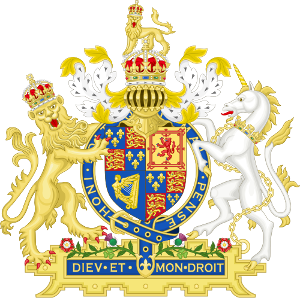
Recommended Reading
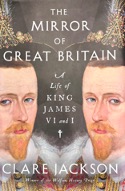
For a deeper dive into the life story of King James I, we encourage our readers to purchase a copy of a relatively new book entitled “The Mirror of Great Britain: A Life of King James VI and I” (2025) by Clare Jackson, a noted historian who is an Honorary Professor of Early Modern History at Cambridge University. Her prodigious research included never-before original manuscripts and correspondence, all of which sheds new light on the life of the first Stuart King of England, and whose reign gave rise to the “Great Britain” we know today as the United Kingdom.