The history of Plymouth Colony begins with the landing of the Mayflower in 1620, and ends with the Colony’s absorption into the Massachusetts Bay Colony in 1691. In between these two events, hundreds of English settlers came to the Colony to make new lives, and several generations of Americans were born and raised in Plymouth Plantation, many of them the children or grandchildren of the original Mayflower passengers. The last surviving Mayflower passenger, Mary Allerton, died in 1699.
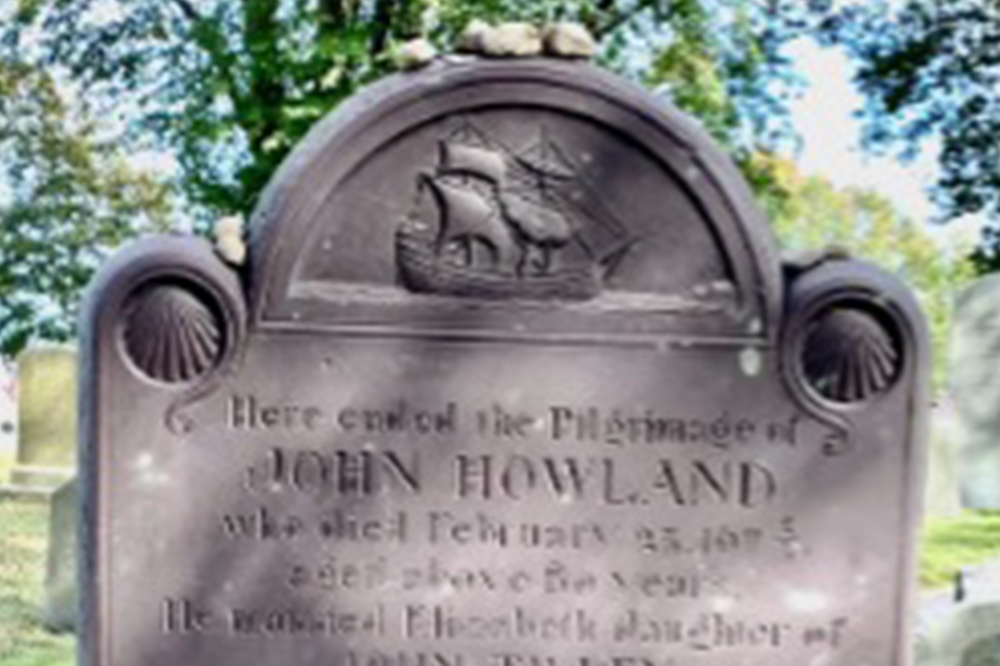
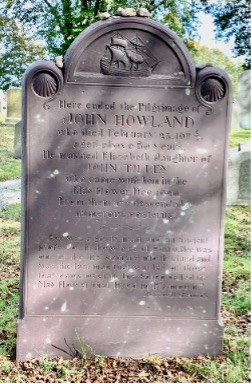
One of the most unlikely of the original Mayflower passengers to leave a lasting legacy was John Howland. Why do we say unlikely? First, he came over on the Mayflower as a servant to one of the other passengers, future Governor John Carver. Second, Howland almost drowned on the way over, having been swept overboard during a violent storm at sea, and saved at the last minute by sheer luck. After he miraculously survived, Howland went on to become one of the leaders of the Plymouth Colony, and it is estimated that today there are well over ten million living Howland descendants in America—a lasting legacy indeed. We honor him today on the anniversary of his death on February 23, 1672.
What do we know of John Howland’s background? He was born about 1599 in Huntingdonshire (Cambridgeshire), England, the son of Henry and Margaret Howland. We know that he had two brothers, Henry and Arthur, who later became Quakers, and who emigrated to America a few years after John. Not much else is known of John Howland’s life in England, including how he came to be a servant to John Carver, who lived in Suffolk County, and would not likely have sought out a servant living 100 miles away from him. In his “Of Plymouth Plantation,” William Bradford says only that Howland was a “manservant” to Carver, and nothing else. Carver and his wife were living in Leiden, Holland, by 1615. Howland may have become a servant to the Carvers in England before their emigration to Holland, when Howland would have been in his early- to mid-teens. One of the leading scholars on the Mayflower passengers, Caleb Johnson, has suggested a possible link between John Howland and the Carver family via Carver’s wife Catherine White’s sister Jane, but the link is extremely tenuous, based on a 1623 “indenture” that refers to a “John Howland, citizen and salter of London,” who was said to have an association with a Mr. Ralph Thickens, brother of Jane White’s husband Ranulph Thickens. No clear and convincing evidence has been discovered to prove that the “John Howland, citizen and salter of London” is the John Howland of Mayflower fame.
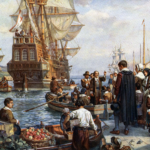
What we do know for certain is that Howland boarded the Mayflower with the Carvers in September 1620, one of 102 passengers bound for North America. The passengers were a mix of “Strangers and Pilgrims,” meaning that some were part of the Separatist religious community seeking religious freedom in the New World (“Pilgrims”) and some were there for purely practical reasons (“Strangers”). An example of the latter was John Alden, who was a “cooper” by trade (a maker of barrels), and was on the ship to serve that function. Howland might better be described as “other”—he was there as a servant.
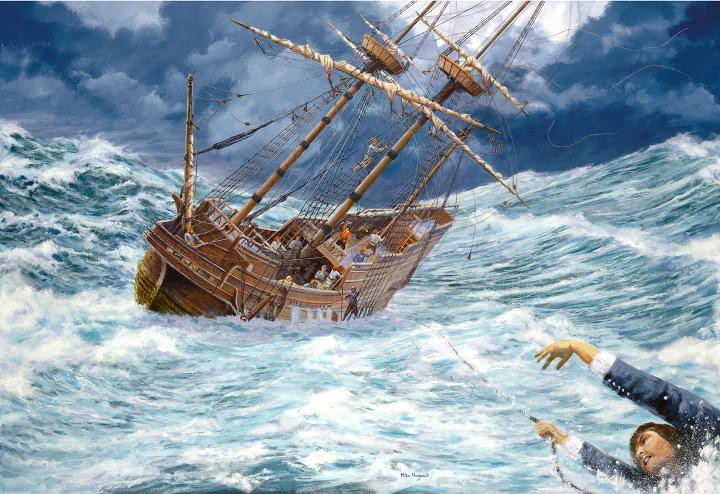
One of the most dramatic stories about the voyage of the Mayflower directly relates to John Howland. During the voyage, the ship encountered a fierce storm, and future Governor William Bradford captured the scene as follows:
“In a mighty storm, a lust young man called John Howland… was thrown into sea, but it pleased God that he caught hold of the topsail halyards which hung overboard… til he was hauled up… and then a boat hook… his life saved. And though he was something ill with it, yet he lived many years after and became a profitable member both in church and commonwealth.”
No record has survived to tell us about the aftermath of Howland’s near-death experience at sea, and Howland himself left no diary or correspondence to illuminate the episode. This is not necessarily because he could not read or write—on the contrary, when Howland died in 1672, the inventory of his estate included several books, including “1 Great Bible and Annotations of the 5 Books of Moses.” While this is not definitive proof of Howland being an educated man, it certainly suggests that he was literate.
Whatever his education was, Howland must have been a respected member of the ship’s passengers, as he was one of the men who signed the Mayflower Compact—an unusual thing for a servant to do. We see his signature on the famous Compact here:
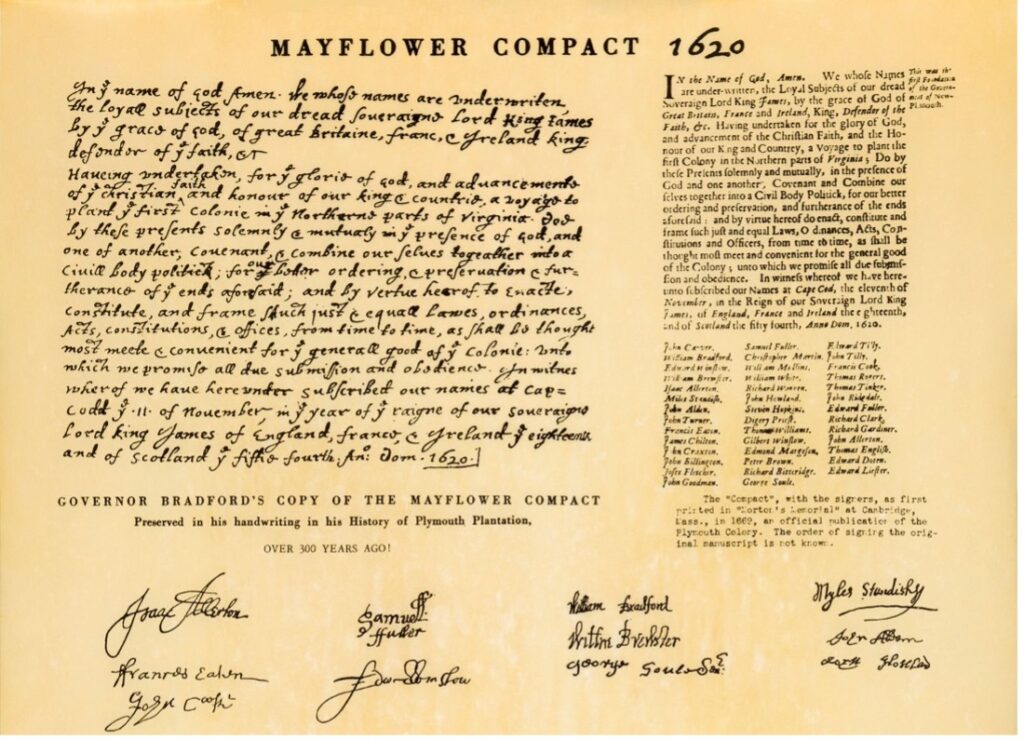
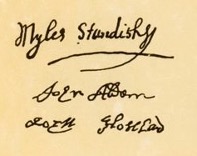
When the Mayflower finally dropped anchor at Cape Cod in November 1620, John Carver was elected Governor of the Colony, which no doubt would have given Howland instant status in the Colony had Carver not passed away just a few months later in April 1621, one of the many Mayflower passengers who died that first winter of 1620-21. This left Howland without a master, and Carver’s wife Katherine also died just months later. Howland was now on his own. Also on her own by April 1621 was Elizabeth Tilley, daughter of John and Joan Tilley. The Tilleys had been passengers on the Mayflower, but John and Joan died sometime between January and March 1621, leaving Elizabeth an orphan. No doubt John Howland and Elizabeth Tilley had already gotten to know each other in the cramped confines of the Mayflower during its two-month voyage. Now they were two young people with no families, and they soon found themselves in love. They married in 1623, and remained together for the next half-century, over which time they produced ten children. Their first child, Desire, was born in 1625, and their last child was born in 1649—almost a 25-year spread!
Consistent with the evidence that Howland was well regarded by the other Mayflower passengers, he soon began to take on a leadership role in the Colony. By 1622/23, Howland was serving as Assistant Governor to Governor Bradford, an important position in the new Plymouth Colony. Thereafter he took on other important leadership roles. He was a member of the Plymouth General Court throughout the 1640’s to 1660’s, and a member of the “Committee on Fur Trade.” He also became a reasonably well-heeled landowner, as evidenced by his last will & testament in 1672, in which he bequeathed many tracts of land to his many children. While not quite a “rags to riches” story, it’s clear that John Howland worked hard, had good business sense, was a good husband and father, and lived to a ripe old age.
This is not to say there that there were no bumps or bruises during his half-century in Plymouth. A famous incident in 1634 demonstrates how volatile life was like in the early years of New England—an incident in which Howland quickly found himself embroiled in a major political fight between the Plymouth Colony and the newly established Massachusetts Bay Colony, led by John Winthrop of “Winthrop Fleet” fame.
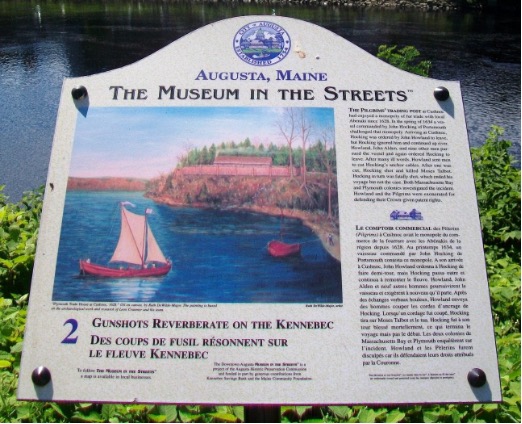
The incident in question was the result of an apparent “turf battle” involving a fur trading post that Howland had established on the Kennebec River, north of Plymouth, and also just north of the newly-emergent Bay Colony based in Boston. For some time, Howland and several other Plymouth men had been operating a successful fur trading business on the river, and dominated trade with the neighboring tribes. In 1634, a man named “Hocking” suddenly appeared at the trading post on a day when Howland was there, and a violent confrontation ensued.
The short version: Hocking claimed that Howland’s trading post was on the Bay Colony’s land, it was an illegal business, and Hocking was going to take it over. Tempers flared, and Hocking drew a gun and shot one of Howland’s men dead. In return, one of Howland’s men shot Hocking dead. As William Bradford later wrote, the incident was “one of the saddest things that befell them since they came…” When news of the shoot-out reached the leaders of the Bay Colony, they were enraged, and decided to capture and imprison whoever from the Plymouth Colony they could quickly apprehend—which turned out to be John Alden, who had had nothing to do with the incident! A tortuous legal case then followed, in which representatives of the two Colonies engaged in a war of words. Ultimately, the dispute was resolved, no one was jailed, and Alden was freed from his captivity. A historic marker now marks the spot where the incident took place:
Despite the blemish of the “Hocking Incident,” historians agree that Howland led an exemplary life. Today, he is one of several Mayflower passengers who has a heritage society dedicated to his memory: The Pilgrim John Howland Society, established in 1897. The Society owns the “Howland House” in Plymouth, which it acquired in 1912, and which serves as a museum that is open to the public. The Society also owns a parcel of land in nearby “Rocky Nook,” the site of John Howland’s home that he built for his family in 1638 (by which time he already had six children!). For further information about the Pilgrim John Howland Society, you can go to pilgrimjohnhowlandsociety.org.
So, today we honor the memory of John Howland, a Mayflower passenger who left a lasting legacy, as millions of Americans can attest.