For many Americans, the history of 17th Century New England conjures up images of hardy immigrants making their way across the ocean, taming nature, and bringing European cultural, social and religious values to the New World. A truer image would need to include disease, food shortages, religious intolerance, and—most relevant to today’s story—abject terror.
Often missing from the picture of happy Pilgrims is any inkling of the human suffering experienced by New England colonists in their ongoing struggle to live peacefully alongside the Native Americans whose lands they were now sharing. More often than not, there was little peace, and the threat of Indian attacks was omnipresent in the lives of New England colonists in that first century of European settlement. A prime example was King Philip’s War, which erupted in 1676, an all-out war between an alliance of Native-American tribes and the New England colonies. That war is a story in and of itself, one that we will write about in other stories in 2026, the 350th anniversary of that bloody contest for control of New England.
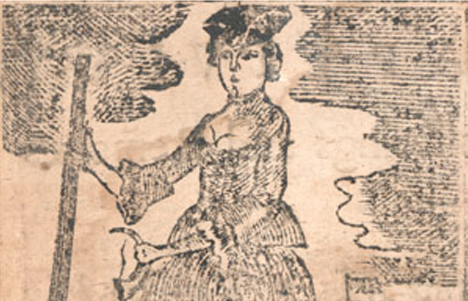
Today’s story is about one person who survived incredible hardships during King Philip’s War, and lived to write about it: Mary Rowlandson, a wife and mother who lived with her family on the Massachusetts frontier. She was married to the town minister, the Reverend Joseph Rowlandson, and together they were the parents of four children. When King Philip’s War broke out in February 1676, Indian warriors attacked a number of settlements, including Lancaster, where the Rowlandsons were then living. The attack turned into a wholesale slaughter of men, women and children. One of Mary’s daughters, Sarah, was seriously injured and soon died from her wounds. The Indians captured many of the townspeople, including Mary and her three surviving children. What followed was a harrowing 11-week ordeal, as Mary was taken from place to place as King Philip’s warriors moved around New England, battling with the colonists. Towards the end of the war, it was a battle for survival, as King Philip and his men were chased by the colonial soldiers and they were running out of food, shelter, clothing, and ammunition. As the warfare continued, Mary was separated from her surviving children the entire time, and she had no idea if they were alive or dead. Husband John had managed to escape capture, and anxiously awaited word of what had become of his wife and children.
What was most remarkable about her terrifying experience was that she not only survived, but that she decided to write about her captivity. Although it took her six years to fully compose her thoughts and put pen to paper, she produced a masterpiece. Published in 1682, the book was released under the title of “The Sovereignty and Goodness of God: Being a Narrative of the Captivity and Restoration of Mrs. Mary Rowlandson.”
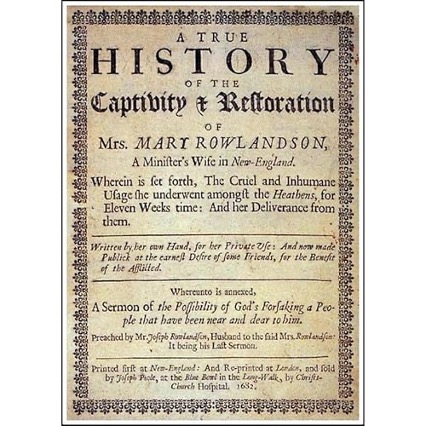
The book was surprising in some respects. Mary recounted, for example, that while a captive, she was treated honorably by her captors, and by King Philip himself. She may have surprised many of her readers when she said that “not one of [the Indians] ever offered the least abuse of unchastity to me in words or action.” Mary thanked God for her survival, which resonated with colonists whose lives were inseparable from their faith. While some historians suggest that Mary may have been helped in writing the book, it is unarguable that the book was her own powerful first-person “captivity narrative.” Colonists devoured her book, and made Mary a celebrity of sorts, both in New England and in the mother country.
Mary’s return to civilization was part of a negotiated deal between King Philip and the colonists. On May 2, 1676, she was ransomed: a group of women in Boston collection 20 English pounds to pay for her release, and the release of her surviving children. She reunited with her husband John, and the family moved the following year to Wethersfield Connecticut, where he became the local pastor. She lived a long life after her captivity, and passed away on January 5, 1711.
So today we honor the memory of Mary Rowlandson, a courageous woman who wrote one of the most compelling first-person accounts of the violent times in which our New England ancestors lived, and the faith with which they faced death during those troubled years of warfare between Native-Americans and the people of New England.