One of the most tragic events at the Jamestowne Colony in its early years was the Massacre of 1622, in which many settlers lost their lives. One of them was George Thorpe, who had worked tirelessly since his arrival in Virginia in 1620 to establish a college at which the settlers’ children could be educated, as well as a school for Native-Americans. In 1620 he was given the responsibility to acquire the land on which the College of Henricus would be built, and to obtain the needed funds for the project from Virginia Company investors, members of the clergy, and other donors. He also quickly added to the ranks of the Governor’s Council, and served as one of the governors of “Berkeley Hundred,” a new plantation on the James River (it was there that the first “Thanksgiving” was celebrated in 1619). Thorpe also took it upon himself to form positive relationships with members of the neighboring tribes, including the new leader of the Powhatan tribe, Opechancanough, for whom he built a home fashioned after the homes of aristocrats in England. On the business front, Thorpe is credited with making the very first batch of corn whiskey, which he debuted in 1620.
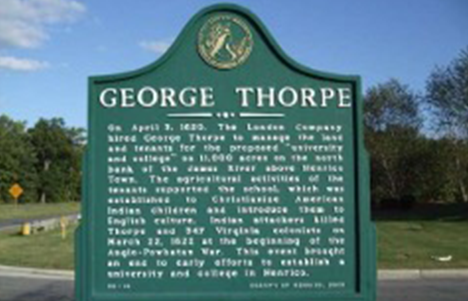
Despite all his earnest efforts to live peacefully and productively alongside the Native-American tribes, Thorpe was not spared from the mayhem that took place on March 22, 1622. His plantation was attacked that day, and although he had been warned that such an attack might come, Thorpe was still at Berkeley Hundred when the violence was unleashed. As recounted by a witness to the attack (quoted in David Price’s excellent book, “Love and Hate in Jamestown”), the attack was horrific: after stabbing and bludgeoning Thorpe to death, the Indians “cruelly and fiercely, out of devilish malice, did so many barbarous despights and foule scornes after to his dead corpse as are unbefitting to be heard by any civill eare.” Thus ended the life of one of Jamestowne’s most vocal advocates for the fair and humane treatment of the Native-Americans (however misplaced those views might have been to his fellow colonists). His dreams for the College of Henricus never materialized, and his plantation was abandoned. Thorpe was survived by his wife Margaret and two sons, who fortunately were living in England at the time of the massacre. Hundreds of years after Thorpe’s death at age 45, Henrico County honored him in 2000 with a historical marker, placed at the site of what was to be his college.
So today we honor the memory of George Thorpe, who was baptized in England on this day on January 1, 1576, 350 years ago.