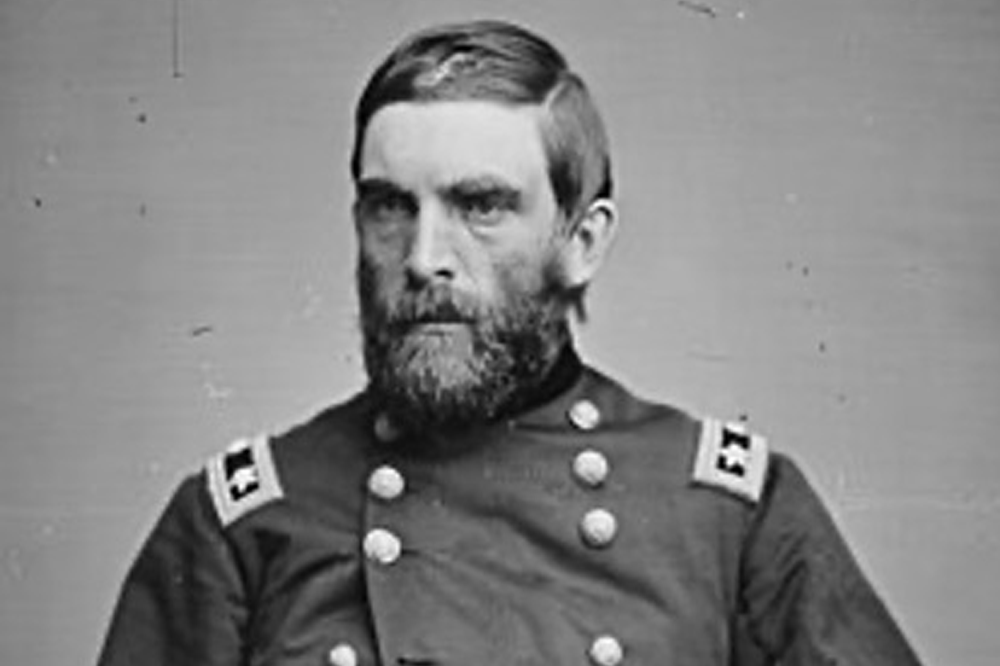
The American Civil War produced a long list of generals who led men into battle, and in some cases became American heroes: Ulysses S. Grant, William Tecumseh Sherman, and Philip Sheridan come to mind, all of whom we’ve written about in the past. One Major General who’s received much less attention—unless you’re a railroad buff—is Grenville Dodge, who died this day on January 3, 1916, 110 years ago. Unlike most Civil War heroes, Dodge has gone down in history for what he did after the Civil War, and for the critical (if largely forgotten) role he played in the history of the American West.
Born in 1831 in Massachusetts, Dodge developed an interest in surveying at a very early age (not unlike George Washington a century before). At the age of 20 he graduated from college with an engineering degree and became a surveyor for the Illinois Century Railroad, and later for the Union Pacific Railroad. By the time of the outbreak of the Civil War in 1861, Dodge was an experienced and well-regarded surveyor, and was quickly enlisted to assist the Union Army in delivering supplies of ammunition and other necessities to the front line. In that capacity, he also was called upon to ensure that the rail lines that carried needed provisions and ordinance to the troops were in good repair, and were being adequately protected from attacks by the Confederate Army.
During the war, Dodge led troops into battle, and he generally performed well in the role of a military commander, but his expertise in railroads became more and more important to the Union cause than his military exploits. Indeed, his talents caught the attention of President Abraham Lincoln, who commissioned Dodge to identify the best starting point for a potential transcontinental railroad. Dodge did so, and Lincolns issued an executive order affirming Dodge’s proposed location along the Missouri River for a transcontinental rail line to start.
Besides his obvious expertise in railroads, Dodge also developed a talent for spying, and during the war he established a network of Union spies known as the “Corps of Scouts.” The human intelligence his spies generated was priceless, and he pioneered the use of various intelligence-gathering tools of the trade, such as tapping telegraph lines, encrypting communications, and the like. He was so good at spy-craft that by 1863 he was providing his intelligence directly to General Ulysses S. Grant.
But it was Dodge’s post-War talents that has left the most lasting legacy. With the approval of Generals Grant and Sherman, in 1866 Dodge was made the chief engineer of the Union Pacific Railroad, which was to be responsible for the laying of track from Omaha west, through the Rockies, where it would link with the tracks being laid by the Central Pacific Railroad from Sacramento east. Before the war ended, Dodge had stumbled on what he thought might be a viable route for a transcontinental rail line, and as the Union Pacific’s chief engineer he went to work to survey the route and develop a concrete plan to build the line. His efforts were massively successful, and most historians credit Dodge with being the key engineering genius to make the Transcontinental Railroad a reality. It weas in 1869 that his efforts met fruition with the “Golden Spike,” linking the rail lines of the Central Pacific and Union Pacific, and linking the East and West coasts of America for the first time. One historian has concluded that Dodge’s efforts were “more important in the national life after the Civil War than his more famous colleagues and friends, Grant, Sherman and Sheridan.”
While Dodge was helping build the Transcontinental Railroad, he also became involved in politics, and was elected a congressman from Iowa in 1866. He also served as a delegate to the Republican National Convention in 1868, which nominated his friend Ulysses S. Grant as the Party’s nominee for President.
Dodge lived a long life, and accomplished what few men would ever hope to accomplish. He died on January 3, 1916 at the age of 84, and was buried in his hometown of Council Bluffs, Iowa. And so today we honor the memory of a great American, Grenville Dodge, through whose dedication and tireless efforts, America was transformed.