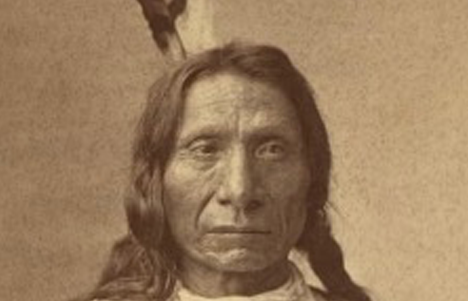
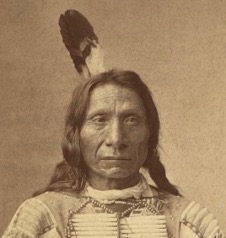
We’ve written before about some of the greatest Native-American warriors of the 19th century: Crazy Horse, Chief Joseph, and Quanah Parker, to name a few. Today we write about another of the great warriors of that era: Red Cloud, who died this day on December 10, 1909.
During the Indian Wars in the late 1860’s, Red Cloud was a central figure, leading his warriors into battle during what became known as Red Cloud’s War, which was actually a series of battles in the period 1866 to 1868. In those battles he led the Oglala Lakota, a tribe that at that time was one of the most hostile foes of American settlers. He fought alongside Crazy Horse at the Battle of the Hundred Slain in December 1866, otherwise known as the Fetterman Massacre (named for Captain William Fetterman, who was slain in the battle along with his entire detachment of eighty-one soldiers).
Although a fierce warrior, Red Cloud also understood that his people were potentially facing annihilation, and he soon found himself part of the allied tribes that entered into the Treaty of Fort Laramie in 1868, in which the United States agreed to abandon its forts in Lakota territory, and set aside lands in the Black Hills and Big Horn to serve as a home for the Lakota tribe. Within just a few years, however, Red Cloud and his people were moved to a reservation at Fort Robinson in present-day Nebraska, under the jurisdiction of the U.S.-run “Red Cloud Agency.”
Peace did not last long. In 1874, gold was discovered in the Black Hills, and suddenly the area inhabited by Red Cloud and his people was fair game for white settlers. Matters came to a head in May 1875, when Red Cloud and other Native-American leaders went to Washington D.C. to meet with President Ulysses S. Grant, who proposed a pay-off: the U.S. government would pay $25,000 to the tribes, if they moved elsewhere. The Indian leaders rejected Grant’s proposal, and warfare quickly followed. In 1876, the Great Sioux War broke out, in which Sitting Bull, Crazy Horse and their Indian allies worked together to fight the Americans—most famously at the Battle of Little Big Horn. Red Cloud was not part of that battle, nor was he involved in the Great Sioux War in general.
Ultimately, after several forced moves of his people, Red Cloud ended his life at the Pine Ridge Indian Reservation in South Dakota. In 1884, he converted to the Catholic faith. He continued to seek peaceful solutions, and to oppose the ongoing efforts of the U.S. government to take away lands that had been granted to his people by treaty.
Despite his efforts, Red Cloud went to his grave having failed to stop the relentless westward expansion of American settlers, and the dispossession of his people from their native lands. He died on December 10, 1909 on the Pine Ridge Reservation, where he is buried. According to some historians, he was the “most photographed American Indian of the 19th century.” He is the subject of a number of monuments and tributes, and today we honor his memory as well.