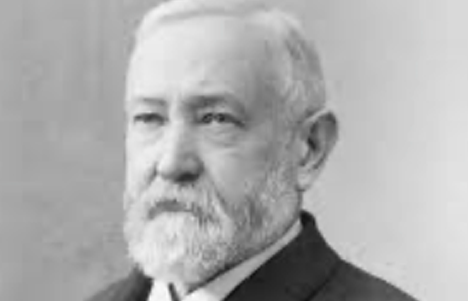
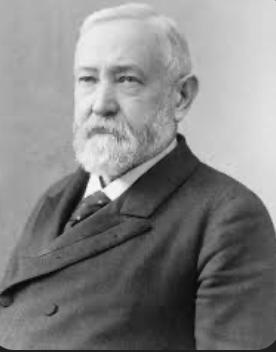
Born on August 20, 1833, Benjamin Harrison was the 23rd President of the United States (served, 1889-1893). He was a descendant of a prominent Virginia family, and was the grandson of William Henry Harrison, the 9th President of the United States. Benjamin’s adult life was marked by many accomplishments: a colonel in the Civil War, a U.S. Senator from Indiana, a lawyer, and a church leader. As President, he signed the Sherman Anti-trust Act, which outlawed monopolies, price-fixing, and other anti-competitive practices. He also sought— but failed to get— legislation that would have established stronger voting rights for African-Americans. He also supported civil service reforms and pensions for disabled veterans (although the pension payouts led to accusations of corruption). Yet, it was during Harrison’s administration that one of the worst events in the Indian Wars in the West took place: the “battle” of Wounded Knee in 1890. It was Harrison who, following the admission of North and South Dakota to statehood in 1889, ordered troops to go to South Dakota the following year to suppress what was reported to be a growing Indian rebellion there, which led to the massacre at Wounded Knee.
Harrison’s policies had many detractors, and he lost his re-election bid in 1892, and was defeated by Grover Cleveland, who had served as President before Harrison. Historians consider Harrison to have been a man of honesty and integrity, who achieved several major legislative victories during his administration. For that, we celebrate his birthday today.