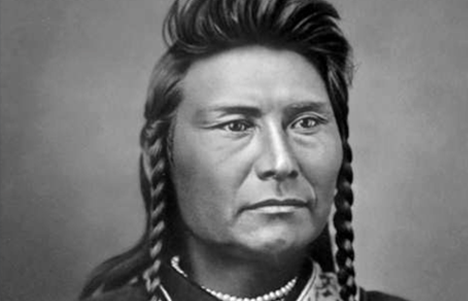
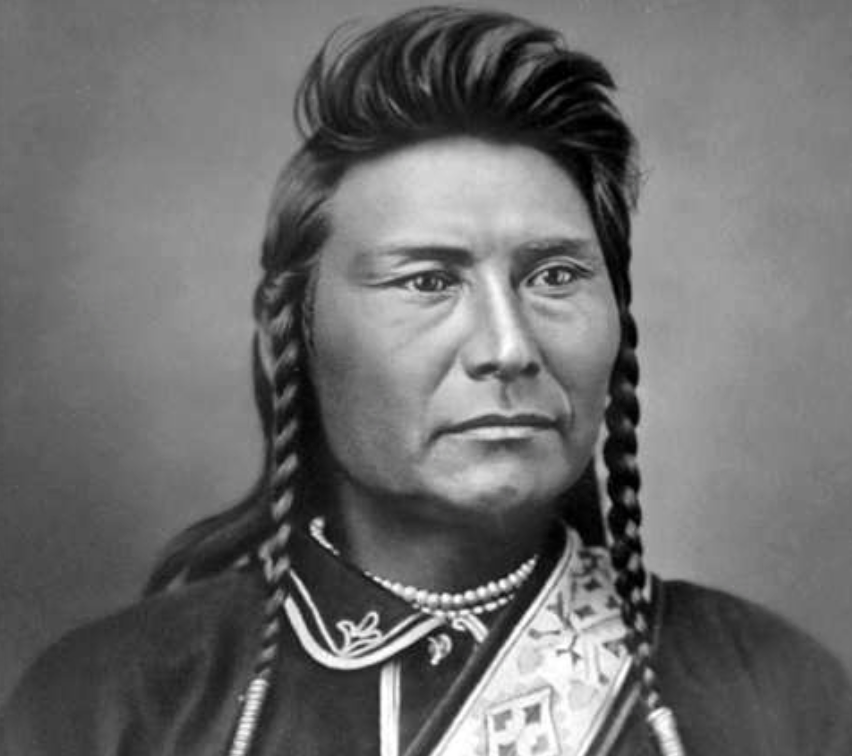
September 21 marks the anniversary of the death of Chief Joseph, one of the most famous Native-American chiefs during the period of our nation’s decades-long “Indian Wars” in the second half of the 19th century. Born in 1840, Chief Joseph led the Nez Perce tribe, then living in the Wallowa Valley in the north east of present-day Oregon. By the 1870’s, the U.S. government was seeking to forcibly remove the Nez Perce from their tribal lands to make room for further white settlement, which Chief Joseph and his people resisted. This resistance ultimately led to the Nez Perce War, which ended with the surrender of the Nez Perce in October 1877. While his people were re-settled onto reservation land, Chief Joseph himself was moved from place to place, ending his life on the Colville Indian Reservation in Washington.
The dispute between the U.S. government and the Nez Perce dates back to 1855, when Chief Joseph’s father, known to white America as “Joseph the Elder,” who had entered into the Treaty of Walla Walla, in which the U.S. Government agreed to give the Nez Perce over 7 million acres of land in Oregon to serve as their reservation. In 1863, however, the U.S. government essentially reneged, and sough to force the Nez Perce to reduce their reservation to a tenth the size, down to 760,000 acres, and move to the Idaho Territory to boot. Open conflict amongst tribal members ensued over whether to accept the new deal. Joseph the Elder insisted on staying put, while another faction agreed to the new treaty and moved.
After Joseph the Elder died in 1871, Chief Joseph took over, and maintained the same stance as his father: his people refused to move, or to accept the terms of the 1863 accord. When the government threatened military action in 1877, and gave him a 30-day deadline to move. War then broke out, and Chief Joseph and his remaining stalwarts decided to move north to Canada, where Sitting Bull and his Lakota Sioux had re-settled. Along the way, several battles took place, with both sides suffering losses, with an estimated 150 Nez Perce warriors having been killed or wounded.
The Nez Perce War ended on October 5, 1877 when Chief Joseph was captured; his people had been stopped just short of the Canadian border. The surviving members of the tribe were transported to Fort Leavenworth in Kansas. It wasn’t until 1885 that the tribe was allowed to relocate to the Pacific Northwest, but not to their homelands. They were placed on the Colville Indian Reservation in the State of Washington, alongside several other tribes that had been resettled there. Chief Joseph died at the Colville Indian Reservation on September 21, 1907. He is buried in the Chief Joseph Cemetery in the village of Nespelem, Washington.
Chief Joseph’s legacy is not unlike that of several other tribal leaders during the period of the Indian Wars. He sought peace, but his efforts ultimately were futile. His warriors fought and died, and the Nez Perce suffered the ignominy of spending the rest of their lives on the reservation. As for Chief Joseph, before he died, he continued to advocate for better treatment of Native-Americans, while perhaps humiliating himself by riding in a parade with Buffalo Bill (not as ironic, however, as Sitting Bull participating in Buffalo Bill’s Wild West shows).
So today we honor the memory of Chief Joseph, whose leadership of the Nez Perce gave voice to the plight of Native-Americans everywhere.