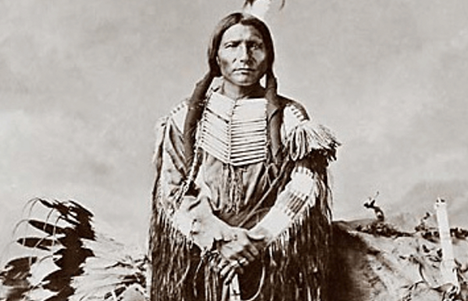
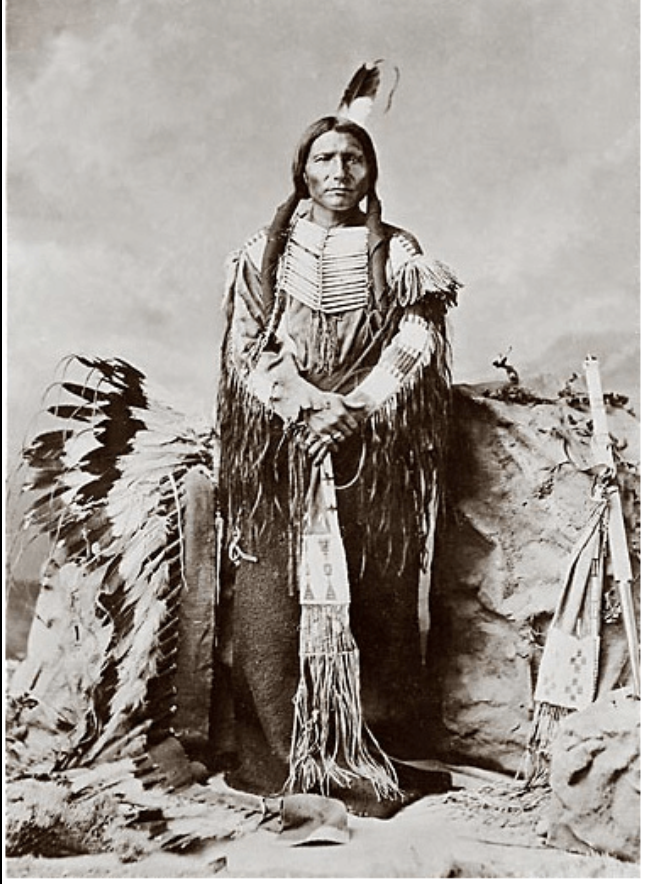
The history of the American West is, in many respects, a history of conquest, as American settlers in the 1800’s migrated west into the lands of various Native-American tribes. Following the Louisiana Purchase, North American tribes were systematically displaced by a combination of treaties, land grabs, and, ultimately, open warfare sanctioned by the American government. The Indian Wars of the 1870’s and 1880’s were the final chapter in this story of conquest. One of the leaders of the Indian opposition was Crazy Horse, who was killed this day on September 5, 1877. His death came after he had surrendered to American troops at the Red Cloud Agency in Nebraska. His surrender came after years of violent conflicts between his Oglala/Miniconjou Sioux band of warriors he led, and American settlers who were coming to the Great Plains in greater and greater numbers following the end of the Civil War.
Born in about 1840, Crazy Horse’s mother gave him his original nickname of “Curly.” After she died, his father, whose name was Crazy Horse, nicknamed his son “Worm.” After the father’s death, the son became the third person in the male line to be named Crazy Horse, and the name stuck. While still in his teens, Crazy Horse was witness to various depredations by the white man. He experienced visions that led him to believe that he was protected from the white man’s bullets, and in fact he was never wounded by a bullet. He lived modestly, and was known for his generosity to his people. Over the 1850’s and 1860’s, he also became known for his bravery and his fighting skills, and he was honored by his tribe as a “Shirt Wearer,” the mark of a war leader. Over the following years, he led his warriors into battle on numerus occasions, most prominently the Battle of Little Big Horn. His battlefield exploits have been highlighted in countless books and movies, and today he ranks among the most famous Indian warriors of his time, alongside Sitting Bull, Red Cloud, Tecumseh, and Quanah Parker.
Crazy Horse’s life ended on a tragic note. When he surrendered to American troops in May 1877, he was confined to the Indian Reservation at the Red Cloud Agency, overseen by U.S. soldiers at nearby Fort Robinson. By August, U.S. Army officers viewed him as a threat, and rumors were circulating that Crazy Horse intended to kill visiting General George Crook. Crook ordered Crazy Horse’s arrest, and ultimately Crazy Horse turned himself in on the evening of September 5. What happened next has been the subject of debate for the last 150 years, but the basic facts are undisputed: he was physically arrested and taken to the guard house at Division Headquarters where, just outside the front door, he was stabbed in the back by a bayonet, and died later that night. Little Big Man claimed that Crazy Horse accidentally stabbed himself in the back. But numerous other eye-witnesses confirmed that he was stabbed by a guard. Either way, his death was the beginning of the end of the Indian Wars. It wasn’t until 1890 that the last major Native-American leader, Sitting Bull, was murdered at a different Indian reservation, followed two weeks later by the Massacre at Wounded Knee. These tragedies marked the end of the war of conquest that had been waged over the course of the 19th century. Today we commemorate the life of Crazy Horse, who fought a losing battle to preserve and protect his people’s way of life.