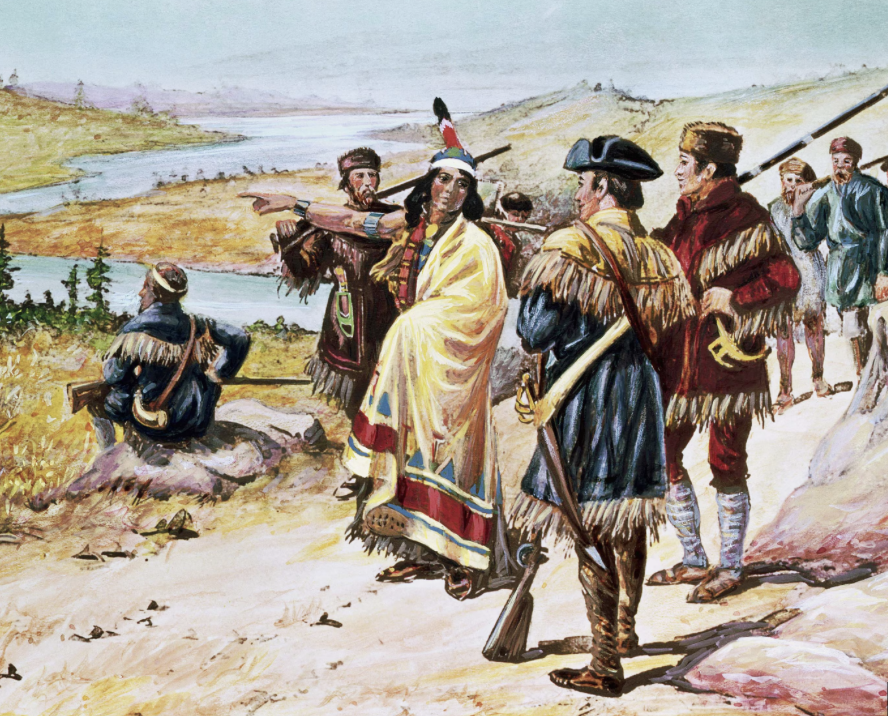
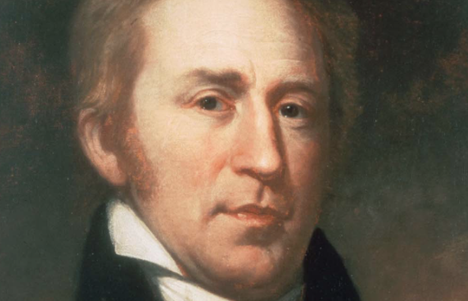
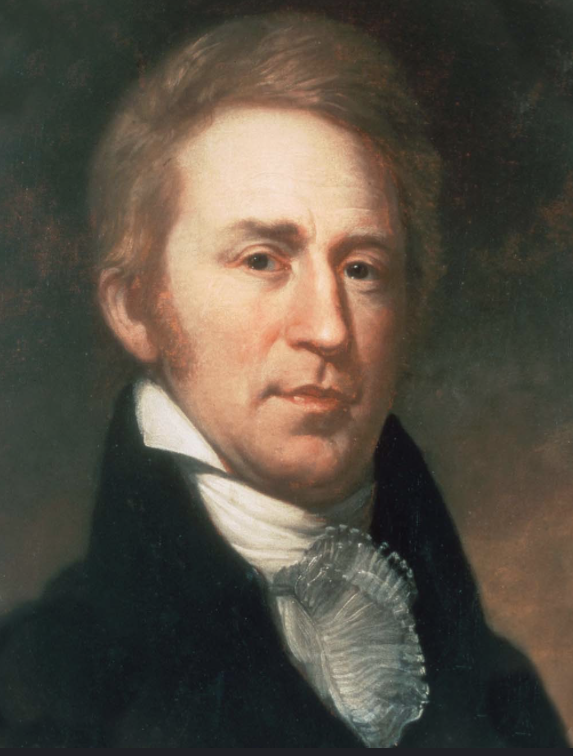
Last month we posted a story about Meriwether Lewis, the famed explorer who co-led the Lewis and Clark expedition of 1804-06. The other leader of that expedition was William Clark, who died on this day in 1838 at the age of 68. He outlived Meriwether Lewis by almost twenty years.
Born in 1770, Clark came from a family of Virginia planters. In 1775, the family moved to a plantation near Louisville, Kentucky, where Clark lived until 1803. His brother George Rogers Clark became a famous frontiersman and Indian fighter, while William joined a Kentucky militia in 1789. He was promoted several times, rising to the rank of lieutenant. He resigned in 1796, having fought in several noteworthy battles during his seven years of service, and having earned a reputation as a leader of men. That may have played a part in Meriwether Lewis’ decision to recruit him in 1803 to join the “Corps of Discovery” commissioned by President Thomas Jefferson to explore the newly acquired lands of the Louisiana Purchase. The story of the Expedition has been the subject of countless books, and we won’t attempt to summarize that story here. Suffice to say that Lewis and Clark returned to “civilization” as heroes. Jefferson promptly appointed Clark to be a brigadier general in charge of troops in the militia of the Louisiana Territory. He was headquartered in St. Louis, where he spent most of the rest of his life.
In the years following the Expedition, Clark came to be sympathetic to the plight of the Native-American tribes, who were methodically being dispossessed of their lands, often by the use of force. Nevertheless, he also was an expansionist, and supported the overall mission to settle the western territories. When the Missouri Territory was formed in 1813, Clark was appointed to serve as Governor, and later on, the Superintendent of Indian Affairs, a position he held from 1822 until his death in 1838. This was a period of intense Western expansion, which triggered inevitable conflicts with the Native-Americans tribes. In 1830 the infamous Indian Removal Act was passed by Congress, and thereafter Clark led the effort to relocate the tribes to the West, as the Act mandated him to do. While he had no choice in the matter, he was generally supportive of President Andrew Jackson’s removal policies, and he aggressively enforced those policies.
Clark’s death on September 1, 1838 was mourned throughout the nation, and a massive number of citizens turned out for his funeral in St. Louis. He and his family members ultimately were buried in Bellefontaine Cemetery in St. Louis. He outlived two wives, but left many children, including his oldest son, whom he named Meriwether Lewis Clark. Clark’s likeness appears on a commemorative coin produced by the U.S. mint in 1904, the 100th anniversary of the Lewis & Clark Expedition, as well as a U.S. stamp issued in 1954 to celebrate the 150th anniversary of the Expedition. In 2024, the Expedition was the subject of celebratory events throughout the United States. We honor him today as one of the most celebrated explorers in American history.