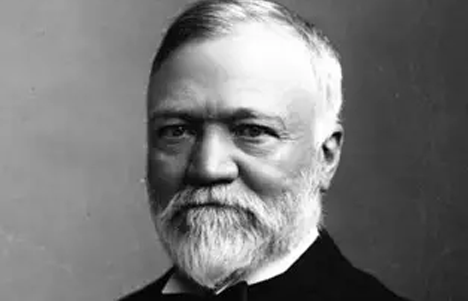
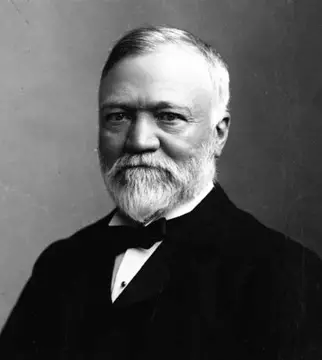
We’ve posted a number of stories about memorable figures in American history who led armies, settled the West, governed our earliest colonies, or distinguished themselves in various fields of endeavor— but not business leaders, some of whom played critical roles in the development of our country. One such person was Andrew Carnegie, who died this day on August 11, 1919. He was a towering figure in the 19th and 20th centuries, whose efforts to develop the American steel industry led him to become one of the country’s wealthiest persons, and a leading philanthropist. His beginnings, however, were ever so humble.
Andrew Carnegie was born in Scotland in 1835, the son of a weaver. By the age of twelve, his father’s business was struggling, and Scotland itself was suffering from food shortages and starvation. Andrew’s mom went to work to support the family, and they were barely surviving. In 1848 the family emigrated to America for a better life, moving to Allegheny Pennsylvania. Father and son went to work in a cotton mill, working 12 hour days. Andrew was then hired by a Scottish “bobbin” manufacturer. The work was brutal, so Andrew moved on to work as a telegraph messenger, where he worked hard and advanced in the business. This led to his employment at the Pennsylvania Railroad Company from 1853 to the start of the Civil War. During the war he put his skills to work, and became a key person in charge of military transportation. After the war, he began his career in the ironworks industry, which ultimately led to his founding Union Steelworks. Over the next quarter century, his steelworks business became an empire, and he founded Carnegie Steel Works in 1892. His fortune was made. In 1901, he sold his company to J.P. Morgan, who folded the business into the U.S. Steel Corporation.
Following his retirement from the steel business, Andrew became one of the world’s leading philanthropists. His gifts provided needed capital to a wide range of charitable causes, and he helped fund the creation of over 3,000 public libraries through the world. In 1900, he donated the funds to form what became Carnegie Mellon University in Pittsburgh. Finally, he established pension funds for his former employees, as well as for college professors (which evolved into today’s TIAA-CREF pension fund). During his lifetime, it is estimated that he gave away almost $6 billion in today’s dollars. He died on August 11, 1919, and is buried in Sleepy Hollow, New York. We remember him today as a rare example of the American Dream personified— a man from humble beginnings who became a titan of industry, and who put his fortune put to work for the betterment of Americans everywhere.