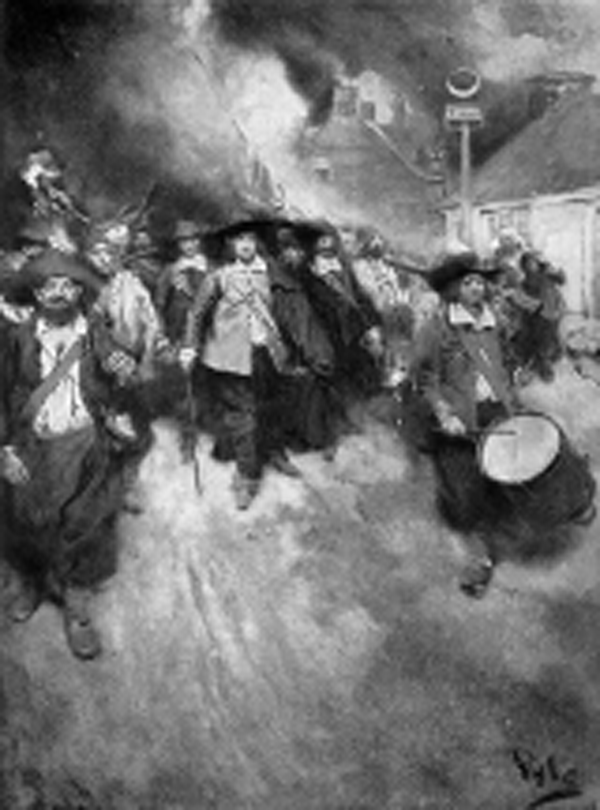
Americans sometimes forget—or never were taught—that the first permanent English settlement in North America was not in New England—it was Jamestown Colony in Virginia. During the 17th Century, the two colonies were linked by trade and commerce, and sometimes by family ties. As well, the people of New England and the people of Virginia experienced many similar challenges: early setbacks caused by disease and starvation; violent conflicts with neighboring Native-American tribes; tense relations with the London-based “Merchant Adventurers” who were backing the Colonies; and oppressive laws imposed on them by the Governors appointed by the Crown to rule over the Colonies. One of the most notorious events in 17th Century North America occurred during the tenure of Governor William Berkeley in the Virginia Colony. It was during his Governorship that Bacon’s Rebellion took place, considered by many historians as America’s first Revolution. The rebellion was named for the leader of the rebels, Nathaniel Bacon, who was born this day on January 2, 1647.
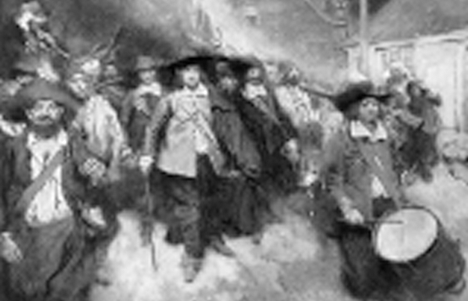
Nathaniel Bacon was the son of a well-to-do English family in Suffolk, England. After graduating from Cambridge University, he studied law at Gray’ Inn. In 1674 Nathaniel’s father funded Nathaniel’s emigration to Virginia, where Nathaniel quickly became a friend of Governor Berkeley. He joined the Governor’s Council in May 1675, and became an influential political leader in the Virginia Colony. Yet, according to the Encyclopedia Virginia, a number of colonists considered Nathaniel to be “unpleasantly arrogant.” Shortly after Nathaniel took office, he began to cross swords with Governor Berkeley over the latter’s handling of relations with the neighboring Native-American tribes, who were carrying out violent attacks on settlements. A group of colonists demanded that the Governor authorize the colonists to fight back against the tribes; and some of them took matters into their own hands, attacking and destroying several tribal villages. This led to retaliatory attacks, and the violence quickly escalated. Governor Berkeley, however, refused to go to war, and instead sought to contain the damage by erecting forts and taking other defensive measures. This did not appease the rebel faction, which by now included Nathaniel. Given his role as a political leader in the Colony, Bacon became the leader of an army of men who overtly challenged the Governor’s authority. Incensed, Berkeley dismissed Bacon from the Governor’s Council and had him arrested. Bacon’s men freed him, however, and in July 1676, Bacon published his “Declaration of the People,” which sought an overhaul of the government, and outright war against the Native-Americans. As the rebellion escalated, in September 1676, Bacon’s men attacked Jamestown itself, and burned it to the ground.
Bacon’s Rebellion was short-lived. Bacon died suddenly of natural causes on October 26, 1676. Governor Berkeley quickly put down the rebellion, and executed several of the remaining rebel leaders. But Berkeley did not fare well, as the Crown blamed him for the insurrection, and removed him from office. He died the following year. Bacon, on the other hand, became a folk hero. Today, he is commemorated on a plaque at the Virginia State Capitol, which honors him as “A Great Patriot Leader of the Virginia People Who Died While Defending Their Rights.” And so we honor him today, on the 378th anniversary of his birth.