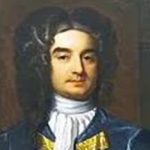
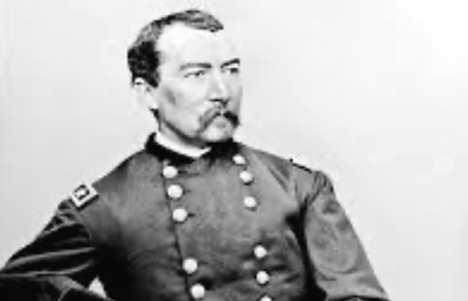
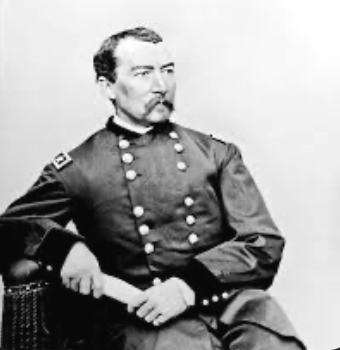
Unless you’re a serious student of the American Civil War, you may not know much about one of the most important generals to lead Union Army troops during the war: General Philip Sheridan, who died this day in August 1888 at the age of 57. Also little known to most people was the role he played after the war concluded as one of the commanding officers who led American troops against Native-american tribes in the Indian Wars of the 1870’s, alongside another illustrious Civil War general, William Tecumseh Sherman. Sheridan is remembered as a ruthless warrior, who over the years gained the trust of Ulysses S. Grant, both during the war and during Grant’s presidency (held office 1869-1877).
Sheridan was born and raised in New York, the son of Irish immigrant parents. He entered West Point at age 17, and graduated as brevet second lieutenant. By 1857 he was a veteran of various military campaigns in the West, including Indian battles in the Oregon Territory and other western regions. During that period he is said to have been living with the daughter of an Indian chief. When the Civil War erupted in 1861, he was promoted to Captain, and served in the Western theatre, where he was made a colonel of a Michigan calvary regiment in May 1862.
Having distinguished himself on the battlefield, he was promoted to general in September 1862, launching his career as a commanding general. When General Grant was appointed General-in-Chief of the Union Army in 1864, he called Sheridan back east to become commander of the cavalry troops of the Army of the Potomac. Sheridan’s battlefield tactics during the “Overland Campaign” were sometimes criticized as reckless or misguided, and his decisions led to significant loss of men and material. But Sheridan was excellent at self-promotion, and Grant chose him to lead the Army of the Shenandoah later in 1864, where Sheridan was sufficiently effective that President Lincoln promoted him to major general in November 1864. He led troops at the Battle of Appomattox Courthouse, where his men were able to cut off General Lee’s escape and force the Confederate surrender that ended the war.
Much can be said about Sheridan’s role in the Indian wars of the 1870’s, much of which is inglorious. His treatment of the tribes has been described as “barbaric,” including deliberate actions to starve out the tribes and— worse— slaughtering Indians in their winter quarters. It was during his command that the infamous Battle of LIttle Big Horn took place, although Sheridan was not on the scene. Sheridan is falsely credited with having said “the only good Indian is a dead Indian.” While Sheridan denied ever saying that, and historians generally agree that he didn’t, the quote is likely a fair representation of his mindset.
After the conclusion of the Indian Wars, in 1883 he was named the Commanding General of the entire U.S. Army. He served in that role until his death on August 5, 1888, after suffering a series of heart attacks. He is buried at Arlington National Cemetery in Arlington, Virginia. His image has appeared on U.S. currency and U.S. stamps, and his name has been affixed to a long list or cities, towns, schools, parks and streets. We remember him today as a military figure who helped win the Civil War, and for that we honor his memory.