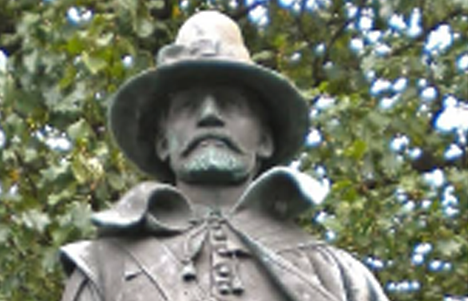
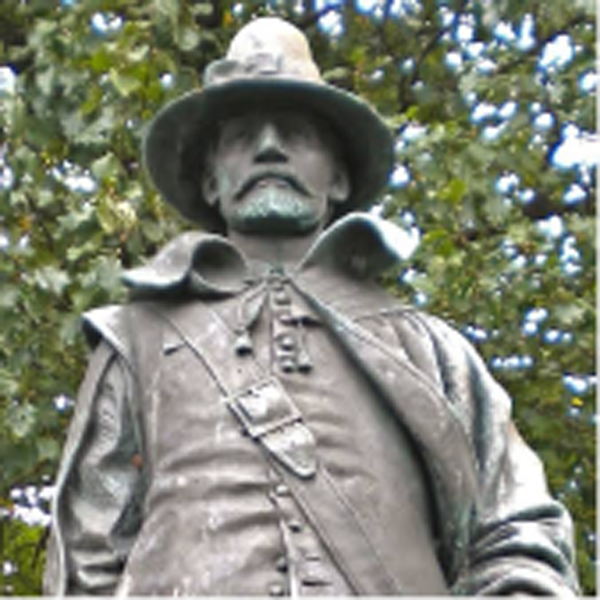
The history of the Mayflower voyage and the establishment of the first permanent English settlement in New England in 1620 has largely derived from the writings of one person—Governor William Bradford, who was baptized on March 19, 1590. We honor him today for his leadership of the English Pilgrims who established Plymouth Colony, and who, through their “Mayflower Compact,” established a representative government that set the standard for future generations of immigrants to North America.
William Bradford is said by at least one historian to have been a descendant of noble ancestry, but if true, he was raised in decidedly straightened circumstances. He was born in Yorkshire, England, and saw both his parents die by the time he was just seven years old. He then lived with his uncles, where he began to read voraciously while working intermittently on the uncles’ farm. At the age of twelve, he began attending church services, and within just a few years he became involved in the “Separatist” movement that was developing in the Yorkshire area. When King James I took the throne in 1603, he launched a campaign to suppress the Separatist movement, and to persecute those who failed to conform to the strict orthodoxy of the Church of England. Bradford soon became a leader of one of the strongest group of English Separatists, who had formed a congregation in Scrooby (in present-day Nottinghamshire). Within a few years, the congregation decided to leave England, and they found their way to Leiden, Holland, where they resided until 1620. It was in that year that a number of members of the Leiden congregation decided to leave for the New World, including Bradford. The rest is history—the Mayflower sailed from England that Fall, and arrived on the shores of New England in November 1620.
Throughout this period, Bradford maintained a journal, today known as “Of Plymouth Plantation,” which recounted the many challenges Bradford and his congregation faced. He described in vivid detailed the Pilgrims’ emotional leave-taking from their homeland, and the daunting they settled in after a harrowing Atlantic crossing (with one Mayflower passenger drowning, and another almost drowning). It is his journal that has become one of the primary sources for modern historians, and its survival after 400 years is a story in and of itself. One leading book, Nathaniel Philbrick’s The Mayflower, makes good use of Bradford’s writings, and we recommend it to you. You’ll found a long list of other books on the website of American Heritage Partners, under the tab “Research Materials.”
After the Mayflower’s arrival at Plymouth, the next several decades saw the Colony struggle to survive, punctuated by several years of general prosperity, and moderate growth. Bradford served as Governor for many years: 1621-1623, 1635-1636, 1637-1638, and 1639-1644. He was a beloved leader, and he guided the Plymouth Colony through some tough times. He also managed to maintain general friendly relations with the Wampanoag tribe and its chief (or “sachem”), Massasoit.
As for Bradford’s personal life, he was married twice, first to Dorothy May, and second to Alice Southworth. Dorothy actually died on the Mayflower after she fell overboard and drowned, after the ship had already crossed the Atlantic and was anchored in Plymouth Bay. With Dorothy he has one son, William, and with Alice he had two sons and a daughter: William, Joseph and Mary. Joseph lived the longest, dying in Plymouth in 1715. Bradford himself lived a relatively long life by the standards of his time: he died on May 9, 1657 at the age of 67. He is buried on Burial Hill in Plymouth.
And so today we commemorate the life and times of William Bradford, one of the most important figures in the history of English settlement of North America, and whose writings provide us with one of the most compelling narratives of life in New England in the first few decades of Plymouth Plantation.