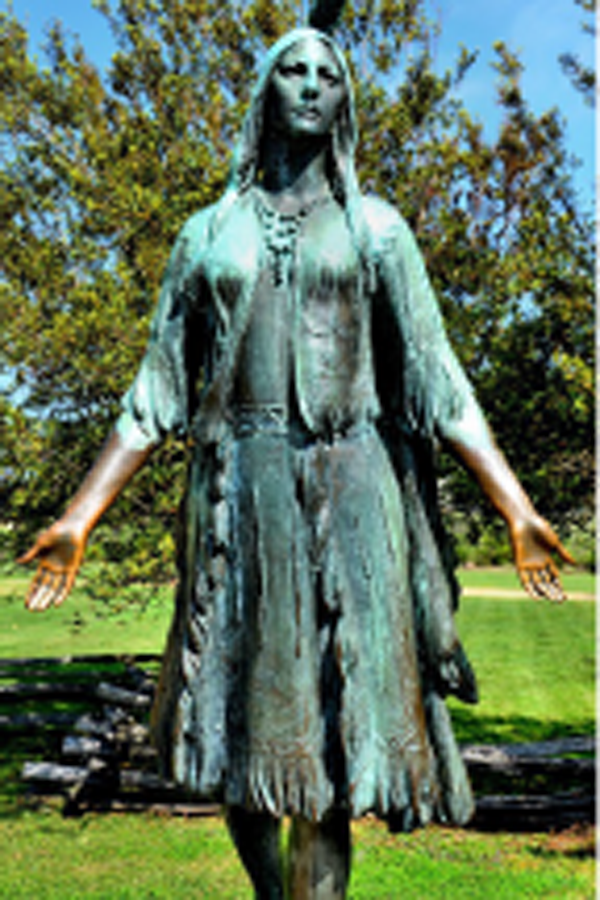
She has been memorialized in many ways by many generations. She’s been the main character in a Disney animated film. She was the very first Native-American to appear on a U.S. stamp. These and similar examples attest to her enduring fame: she is Pocahontas, an Indian princess, who died and was buried this day on March 21, 1617.
The legend of Pocahontas has grown over the centuries, but the basic legend is this: the daughter of the chief of the Powhatan tribe that occupied the area in which the Jamestowne Colony was established in 1607, she befriended the Jamestowne colonists, and became an emissary of sorts between the colonists and the Powhatans and their allied tribes. At one crucial moment, when the Powhatans threatened to kill Captain John Smith, she intervened to save his life. Maybe or maybe not she had a romantic relationship with Smith, although she would have been exceedingly young for that to be true (she would have been 10 or 12 years old, by most accounts). She ended up marrying an English settler, John Rolfe, in 1614, and they had a son. The two then traveled to England, where Pocahontas was the subject of intense interest. As they were about to return to Virginia, she took ill and died in March 1617. Her husband returned to Virginia, where be continued to play a prominent role in the life of the Jamestowne Colony.
While many historians question the veracity of some of the details of Pocahontas’ life story, there’s no doubt that she was a unique character. While she left no writings herself, there are a number of contemporaneous accounts of her activities, including Captain Smith’s own written accounts describing his years in Virginia.
Not all went well for Pocahontas, however. In March 1613, she was captured by the colonists and held for ransom, in hopes that Chief Powhatan would agree to provide food and other provisions for the Colony in exchange for Pocahontas’ release. Instead, Chief Powhatan ignored the colonists demands, and Pocahontas remained in captivity for a year. After her release, she is quoted as having scolding her father that he had valued her “less than old swords, pieces or axes.”
During her captivity, Pocahontas was schooled in the Christian faith, and ultimately she agreed to be baptized and change her name to Rebecca. Also during her captivity, she met her future husband, John Rolfe, and they married in April 1614. By all accounts they had a happy marriage, although a very brief one—less than three years. Their son Thomas was born nine months after the couple married, and they lived at a plantation named “Varina Farms,” located across from the settlement of “Henricus” (names for King James’ son Henry). The marriage helped calm the tensions between the colonists and the Powhatan. Because Pocahontas had become a Christian, the Virginia Company thought that she could be a helpful “ambassador” with the English people, and perhaps help persuade more of them to emigrate to the young Jamestowne Colony. It was decided, then, that the Rolfes would sail to London for a goodwill tour, which they undertook in 1616. While there, Pocahontas was feted at Court, and she made appearances at a number of gatherings of the English nobility. One observer wrote that the Bishop John King has “entertained her with festive state and pomp,” and another commented that Pocahontas “carried herself as the daughter of a King.” As it so happened Captain John Smith was in London when Pocahontas was there. Did they meet? Was there a reunion of these two a decade after Pocahontas had saved Smith from being executed? According to Smith, writing about the encounter later, she rebuked him, and they parted ways.
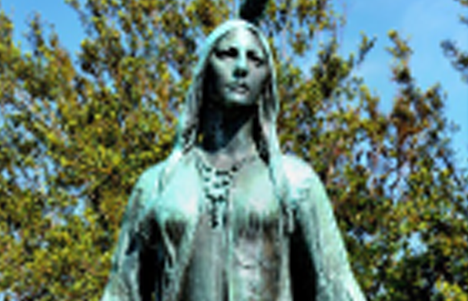
Shortly after the meeting with Smith, the Rolfes prepared to sail home. In March 1617 they boarded a ship and began to sail down the Thames River, and head out to sea. But Pocahontas took ill while the ship was still on the River, and she quickly died, of still-unknown causes. At least one account intimated that she had been poisoned, but there is no evidence supporting that theory. Her funeral took place on March 21, 1617. It is said that she is buried underneath the St. George’s Church in Gravesend. In 1958, a statue was placed near where she is believed to have been laid to rest—an exact copy of the statue that now stands at Jamestowne Fort.
So, today we remember the life of Pocahontas, whose support of the English settlers at Jamestowne was instrumental to the colonists in their efforts to live peacefully alongside the Powhatans and other neighboring tribes. While those relations later broke down, and hundreds of colonists were massacred just a few years later, Pocahontas did what she could to assist the colonists, and to reduce the tensions that existed between the people of Jamestowne and her own Native-American people. For this, we honor her memory today.