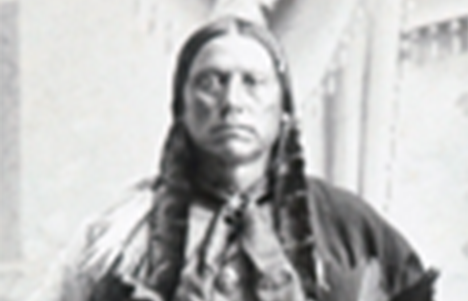
Most of us learned in school something about the most famous Native-American tribal leaders during the period of the settlement of the American West: Sitting Bull, Crazy Horse, and Red Cloud, to name a few. Largely forgotten in the telling of the story of the American West is Quanah Parker, who died of natural causes on this day on February 23, 1911 at the age of about 66.

Quanah Parker lived and died in the Southwest of America, at a time of violent conflicts between American settlers and the Native-American tribes that dominated that vast area, especially the Comanche Nation. Parker was born in Elk Valley, located near the Wichita Mountains in what is now Oklahoma. He was the son of Peta Nocona, a Comanche chief, and Cynthia Ann Parker, a woman deserving of her own biography—a white settler’s daughter who was abducted as a child in 1836, and became assimilated into the Comanche tribe. Her story is a tragic one: after being abducted and then living as a member of the Comanche tribe for 24 years, she was abducted again, this time by the Texas Rangers. She resisted her return to white America, and she ultimately committed suicide in 1871.
Quanah had the warrior’s sprit in his blood. In addition to having a warrior father, he was also the grandson of Iron Jacket, a famous warrior who fought in the earlier Comanche-American wars of the 1830’s and ‘40’s. Quanah had his first taste of battle while still in his youth. After his father’s death in 1864, he was cared for by a tribal chief known as Horseback, and under Horseback’s tutelage, Quanah soon became a leader of various tribal bands. After years of futile battles against American troops under the command of Colonel Ranald Mackenzie—most notably the Red River War and the Battle of Palo Duro Canyon—in 1875 Quanah reluctantly surrendered, and he and his people moved onto a reservation created by the U.S. Government at Fort Sill in Indian Territory, near present-day Lawton, Oklahoma. There, he was appointed by the government to serve as the principal chief of the Comanche Nation (but never elected by his own people to that post). In that role, he interacted with a number of American political and military leaders, and actually went hunting with President Teddy Roosevelt. He is said to have marched in the parade celebrating Roosevelt’s 1905 inauguration. Despite those friendships, and Quanah’s valiant efforts to preserve his people’s reservation lands, the government sold off of over 400,000 acres of their lands to white homesteaders who were flooding into Indian Territory– just one of several examples of mistreatment of Quanah’s people (and breaches of peace accords between the U.S. Government and the Comanche Nation).
In his personal life, Quanah had many wives (eight, according to some historians) and at least twenty-five children. He had almost no contact with his (white) family members on his mother’s side, and they never figured in any meaningful way in Quanah’s adult life. Following his death, a Quanah Parker Society was formed to honor his memory; the Society hosts a family reunion every year in Cache, Oklahoma, where he was initially buried. He now rests in peace at Fort Sill, where he is buried alongside his mother Cynthia Ann, and his sister Prairie Flower. For an excellent history of Quanah’s life and times, we encourage our readers to check out H.C. Brand’s “Empire of the Summer Moon.”
And so today, we remember Quanah Parker—a major figure in the story of the American West, gone but not forgotten.