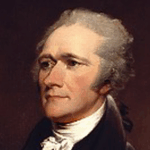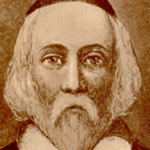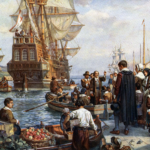
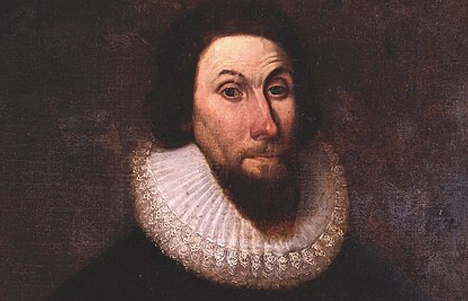
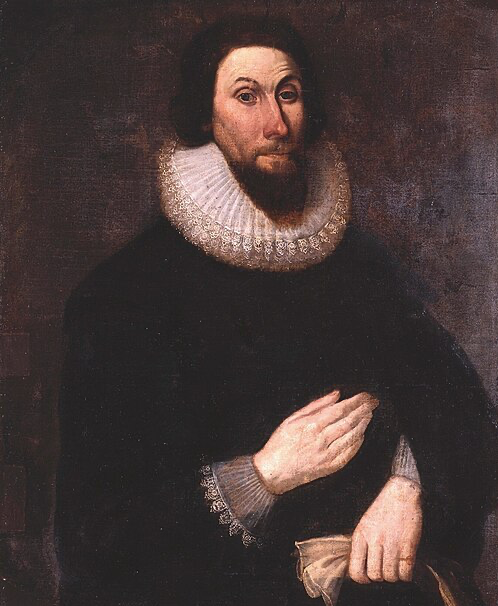
One of the most important political leaders in early New England was John Winthrop, who was born this day on January 12, 1587/1588. Beginning in 1630, Winthrop was the long-time Governor of the Massachusetts Bay Colony, with its center in Boston. In 1629-30, Winthrop had organized and led a large contingent of settlers to sail from England to America, where he established a rival colony to Plymouth, which had been founded ten years earlier in 1620. The fleet of ships he led came to be known as the “Winthrop Fleet,” and the fleet of four ships that arrived at Salem, Massachusetts in June 1630 was the beginning of “The Great Migration,” which lasted a decade and which brought thousands of settlers to the Bay Colony. Winthrop himself served as Governor from 1630 to 1634, then 1637-1640, 1642-1644, and finally from 1646 to his death on March 26, 1649. He presided over the Bay Colony with an iron fist at times, and the history of his leadership of the Colony includes episodes of harsh treatment of religious dissidents, Native-Americans, and anyone else who sought to “rock the boat.” Throughout his four terms as Governor of the Colony, he worked closely with the clergy to ensure that the orthodoxy of the Puritan Church was strictly adhered to, and that its moral codes were enforced. In part due to this powerful alliance of church and state in the Bay Colony, during the 1630-s and ‘40’s the Colony experienced an outflow of colonists who headed elsewhere, and founded other colonies where religious and personal freedom could be enjoyed.
John Winthrop was both in Edwardstone, Suffolk, England in January 1587 to Adam Winthrop, a well-to-do business man and landowner. At Trinity College, John became acquainted with several fellow-students who would later figure prominently in the fortunes of the Bay Colony, most famously Reverend John Cotton. Although John studied law for a time, he was also deeply religious, and kept a diary reflecting his evolving religious thinking. By the late 1620’s, England was experiencing significant religious turmoil, and in 1629 Winthrop joined the Massachusetts Bay Company, where he became a leading proponent of organizing a large migration of Puritan settlers to America. Leaving his pregnant wife behind, he sailed for New England in April 1630 along with 700 other emigrants on four ships. After arriving in June, Winthrop immediately assumed the political leadership of the new Colony, and his views concerning the development of the Colony, including how to deal with religious or political dissenters, were rarely opposed. One of the most prominent examples was the trial of Anne Hutchinson, a religious dissident, who was exiled from the Colony for her non-conformism after an ugly trial presided over by Winthrop. Hutchinson’s case has gone down in history as one of the major black marks on Winthrop’s legacy. As well, under Winthrop, the Colony endured the Pequot War of 1637, which destroyed that tribe—a tragic episode in the life of the Bay Colony, and another stain on Winthrop’s legacy. Perhaps aware that he was making history, Winthrop kept copious journals of his political and personal life, which were later published beginning in 1790; the multi-volume set of his journals were published as the History of New England. Winthrop was a prolific writer, and produced many other works concerning the life and politics of the Massachusetts Bay Colony and early New England. For that, we are all indebted to him for his effort to preserve history.
Today historians are of two minds about Winthrop: while he was at times a harsh tyrant and a persecutor of men and women alike, he also succeeded in establishing a successful colony. Descendants of John Winthrop revere him, of course, which may explain why one of the most exclusive heritage societies in America is the Boston-based “Winthrop Society.” Whatever his flaws, Winthrop was a central character in our early American history. For his contributions to the settlement of New England in the 17th Century, we honor him today, the 438th anniversary of his birth.