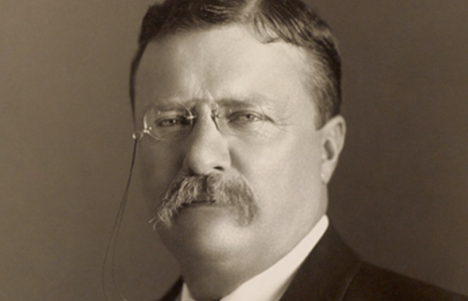
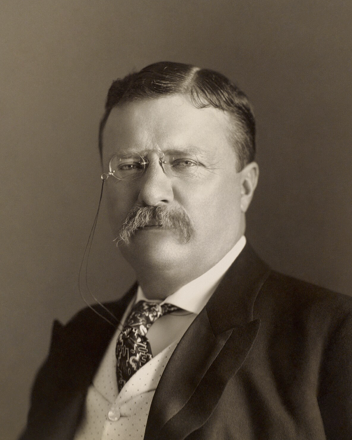
Teddy Roosevelt, the 26th President of the United States, died this day on January 6, 1919 at the age of 60. Besides his many political accomplishments, Roosevelt is remembered as a colorful character who lived life to the fullest: a cattle rancher, a war hero, a naturalist, an explorer, and an author of several popular books, among other pursuits. Some historians consider him one of our nation’s greatest Presidents. He was certainly one of our most memorable presidents.
Theodore Roosevelt Jr. was born in 1858 in New York City. The Roosevelts were descendants of a prominent Dutch-American family, which includes another U.S. President, Franklin Delano Roosevelt. Although as a child Roosevelt was home-schooled, he later attended Harvard College, graduating in 1880, then returned to New York and attended Columbia Law School. After his father’s death, Roosevelt became independently wealthy. He married Alice Hathaway Lee in 1880. She died four years later after giving birth to their only daughter Alice. In the meantime, Roosevelt had begun his political career, joining to the New York State Assembly in 1881. After several political missteps, he retired from politics in 1883 and turned to cattle ranching in the Dakota Territory. In 1886, however, a severe winter storm decimated his herd, and he was forced to abandon the ranch. He returned to New York, where he re-married in December 1886 and also returned to New York politics. In 1894 he became President of the New York Police Commission, and pursued an aggressive reform agenda. By 1898 he was Governor of New York, and being groomed for national office. Just a few years later, he was recruited by William McKinley to be his running mate for the U.S. Presidency. McKinley was elected in 1900, and Roosevelt assumed his position as Vice President in March 1901. Tragically, McKinley was assassinated in September, and Roosevelt was sworn in as President on September 14, 1901 at age 42—the youngest President in American history.
As President, Roosevelt was a reformist and a progressive. While he was a proponent of a strong military, he was also an advocate for peaceful solutions to international disputes, and was instrumental in bringing about an end to the Russo-Japanese War. For this he won the Nobel Peace Prize in 1906. He was re-elected President in 1904. After serving out his term in 1908, he left the Republican party and formed the Progressive Party—a counter-productive move, as the ensuing split vote in the 1912 Presidential election allowed Woodrow Wilson, a Democrat, to be elected President. Roosevelt was a sharp critic of Wilson’s presidency, in particular his leadership (or lack thereof) during World War I. But Roosevelt did not live to see the final outcome—he died just a few weeks after the Armistice signed on November 11, 1918, which ended the war, but which did not end the political conflicts that were resolved (sort of) by the Treaty of Versailles in June 1919 and the formation of the League of Nations in January 1920. Roosevelt passed away at his home at Sagamore Hill, New York, after experiencing several months of respiratory problems, allegedly caused by jungle diseases he may have contracted during his expeditions in the Amazon. The specific cause of death was a pulmonary embolism. He died in the early morning hours on January 6, 1919, and was buried not far from his home, on a hillside overlooking Oyster Bay. Today, Sagamore Hill is a National Historic Site, featuring the Theodore Roosevelt Museum, and is listed on the National Register of Historic Places. We honor his memory today, the 106th anniversary of his death.